






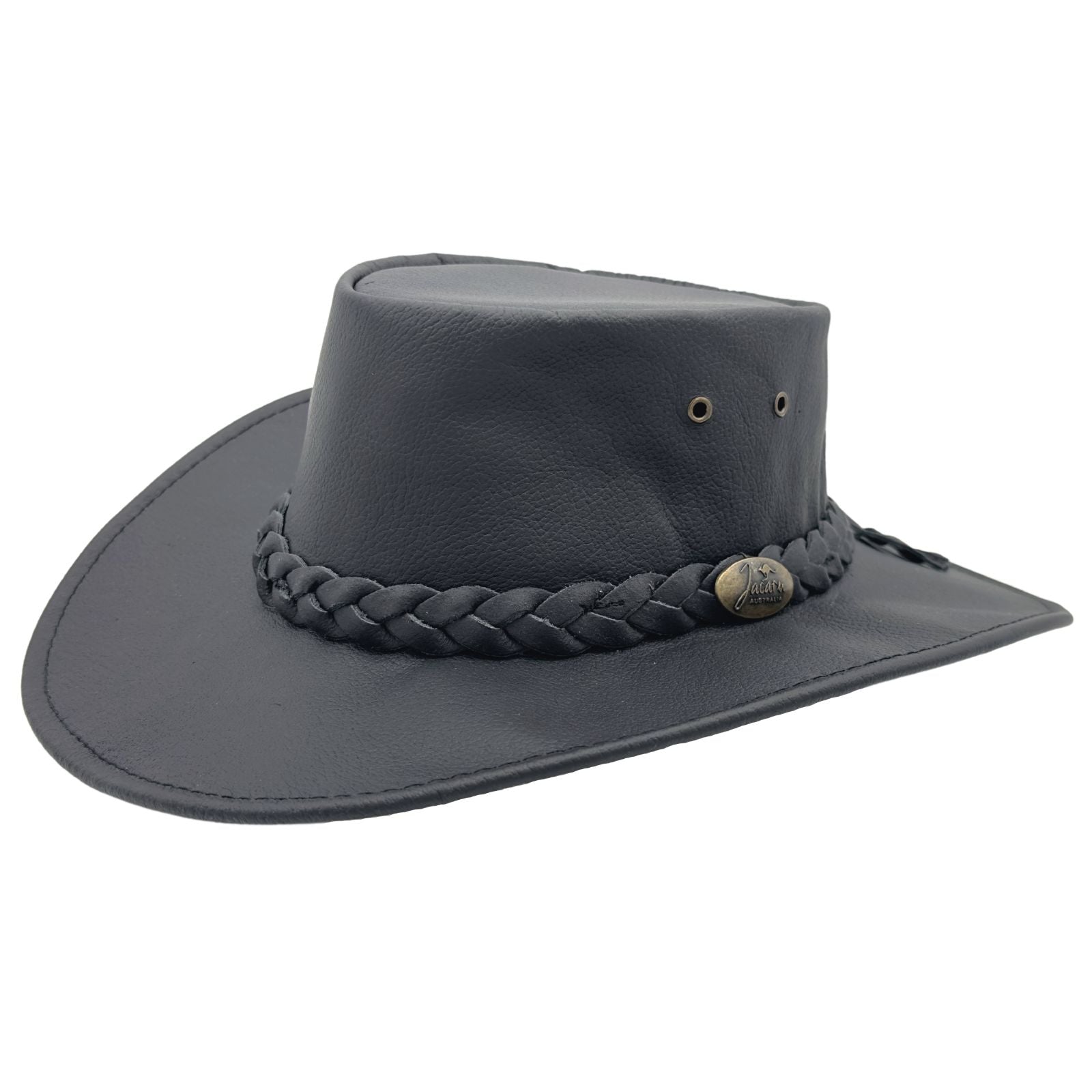


Jacaru Kangaroo Leather Hats: Worth the Premium?

There are hats, and then there are hats built to last a lifetime. If you have spent any time researching quality leather headwear, chances are you have come across the Jacaru kangaroo leather hat, an Australian-made icon with a reputation that stretches well beyond the outback. But does the premium price tag actually hold up under scrutiny, or are you simply paying for the novelty of an exotic material?
In this comparison, we cut through the marketing and put Jacaru's kangaroo leather hats up against the competition. We will examine the material quality, durability, craftsmanship, and overall value to determine whether these hats genuinely outperform their cowhide and synthetic counterparts. You will also get a clear picture of who these hats are best suited for, and where they may fall short depending on your specific needs.
Whether you are a serious outdoors enthusiast, a style-conscious buyer, or simply someone who refuses to settle for average, this breakdown gives you the honest, practical information you need to make a confident purchasing decision.
Kangaroo vs. Cow vs. Buffalo Leather: What the Material Science Actually Says
The difference between a hat that lasts a season and one that outlasts a decade starts at the fibre level, long before any craftsperson picks up a needle or cutting blade.
The Fibre Architecture Advantage
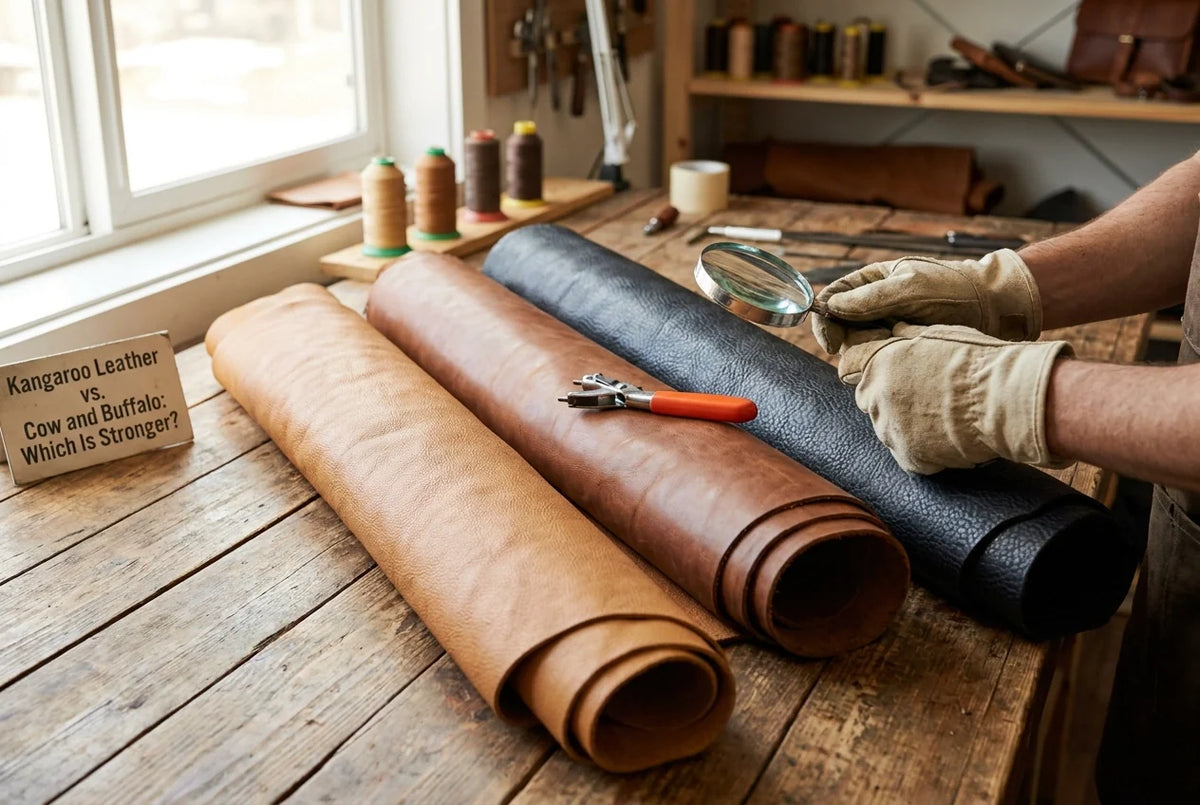
Kangaroo leather possesses a fundamentally different internal structure compared to bovine hides. The fibres run parallel and uniform throughout the entire hide, producing consistent mechanical properties from edge to edge. Cowhide, by contrast, is structurally non-uniform: fibre bundle density, thickness, and orientation vary significantly across different body regions of the same animal, with denser networks at the back and looser, less reliable structures toward the belly. A 2020 peer-reviewed study from the University of Dhaka's Institute of Leather Engineering and Technology confirmed that physical properties including tensile strength, tearing strength, and flexing endurance all vary with body region in bovine leather. For a hat manufacturer, this means cowhide introduces inherent inconsistency into every production run, regardless of skill level.

Tensile Strength Where It Counts
The headline statistic from leather trade literature is difficult to ignore: kangaroo leather has been cited as delivering up to ten times the tensile strength of cowhide at comparable thickness, while remaining significantly lighter. This is not an abstract engineering claim. It is precisely why independent reviewers consistently describe the Jacaru kangaroo leather hat as both "lightweight" and "super durable" in the same breath, two qualities that normally trade off against each other in materials selection. The unique parallel fibre structure allows the hide to be worked thin without sacrificing structural integrity, a property that also makes kangaroo leather the preferred material for pro-level soccer boot uppers and falconry gear, applications where thin, light, and strong must coexist.
Why Buffalo Leather Stays Off Your Head
Buffalo hide is thick, heavy, and genuinely durable, but those same properties that make it excellent for work gloves, rugs, and static protection gear make it poorly suited to headwear. Weight fatigue across a full outback day or a long international transit is a real physical consideration, not a minor comfort preference. The additional mass of buffalo leather creates cumulative strain that kangaroo's superior weight-to-durability ratio simply eliminates.
Standardisation and Sourcing Consistency
Kangaroo leather comes from a single regulated species, harvested under strict Australian government quotas. Because hide thickness is naturally consistent across the species, tanning recipes and cutting patterns can be standardised with a precision that cowhide sourcing cannot match. Cattle vary by breed, age, sex, and geography, and that variation flows directly into hide quality at the production stage. For Jacaru, working with kangaroo leather means quality control benchmarks hold across a production run in a way that bovine alternatives structurally cannot guarantee. For the buyer, it means the hat in the box matches the one that earned the five-star review.
Is Kangaroo Leather Sustainable? The Sourcing Story Behind the Hide

Kangaroo leather occupies a genuinely unusual position in the global leather market, and understanding why requires looking at where the hide actually comes from. Unlike cattle, sheep, or goat leather, kangaroo hides are never produced through farming operations. The animals are wild-harvested under Australia's coordinated state-level Wildlife Trade Management Plans, meaning no land is cleared for pasture, no feedlots are established, and no dedicated water or feed resources are allocated to raise an animal for its skin. The hide is a regulated by-product of population management, not an agricultural commodity.
Government Regulation and Population Management
Australia's commercial kangaroo harvest is one of the most tightly controlled wild-animal utilisation programs on earth. Each state operating within the commercial industry, including New South Wales, Queensland, South Australia, and Western Australia, maintains its own Wildlife Trade Management Plan that sets harvest quotas based on annual population surveys. New South Wales is currently operating under a plan covering 2022 to 2026, which mandates humane practice, ecological sustainability, public accountability, and adaptive management responses to population data. This is not a single national permit; it is a coordinated, multi-jurisdictional framework governed simultaneously by Commonwealth and state legislation.
The ecological rationale matters here. Since European colonisation reduced natural predator populations, kangaroo numbers have grown significantly. Unmanaged, overabundant kangaroo populations degrade habitat for threatened species, compromise revegetation efforts, and compete with livestock for scarce pasture during drought. Commercial harvesting is therefore reframed, accurately, as active ecological stewardship rather than simple exploitation.
The Environmental Case Against Cattle Leather
The carbon footprint comparison with conventional leather is striking. Kangaroos produce roughly one-third of the greenhouse gas emissions of cattle and sheep, primarily because their digestive physiology does not generate the same methane output as ruminants. They also have soft hooves that do not compact and erode soil the way cattle hooves do. Combine this with the complete absence of deforestation, feedlot water consumption, or land conversion, and kangaroo leather carries a substantially lower lifecycle environmental impact per finished product than bovine equivalents. For eco-conscious buyers in 2026, this distinction is increasingly a genuine purchase trigger rather than a footnote.
The Sourcing Transparency Question Every Buyer Should Ask
For buyers weighing ethical sourcing, one question cuts through marketing language: does the brand source its hides from commercial harvesters operating under a current, state-issued licence? This matters because non-commercial kangaroo culling licences have been rising in volume and, in some periods, have exceeded commercial harvest figures. Hides from non-commercial culling do not carry the same traceability or welfare oversight standards as those from the regulated commercial supply chain. Brands that can confirm their supply chain connects directly to licensed commercial operators are offering a verifiable and substantive sustainability claim, not an aspirational one. You can review the sustainability and ethics framework around kangaroo leather for further context on what responsible sourcing looks like in practice.
Jacaru Kangaroo Leather Hat Models Compared: Which One Fits Your Needs?
Not all Jacaru kangaroo leather hats are built for the same purpose, and choosing the right model comes down to matching the hat's design priorities to your actual use case.
The 3-Piece: Built for Travellers Who Refuse to Check a Hat
The Jacaru Kangaroo 3-Piece hat review from Hats By The Hundred describes it plainly: "fully waterproof and packable, making it a great travel companion." That description points directly at the model's defining advantage. Because the crown is constructed from three stitched panels of kangaroo leather rather than a single moulded form, it can be compressed flat, packed into a bag, and reshaped on arrival without losing structural integrity. For long-haul travellers, overlanders, or anyone who refuses to surrender overhead bin space to a rigid hat box, the 3-Piece is the practical answer in the Jacaru range.
Breeze Models: Ventilation First for Active Outdoor Use
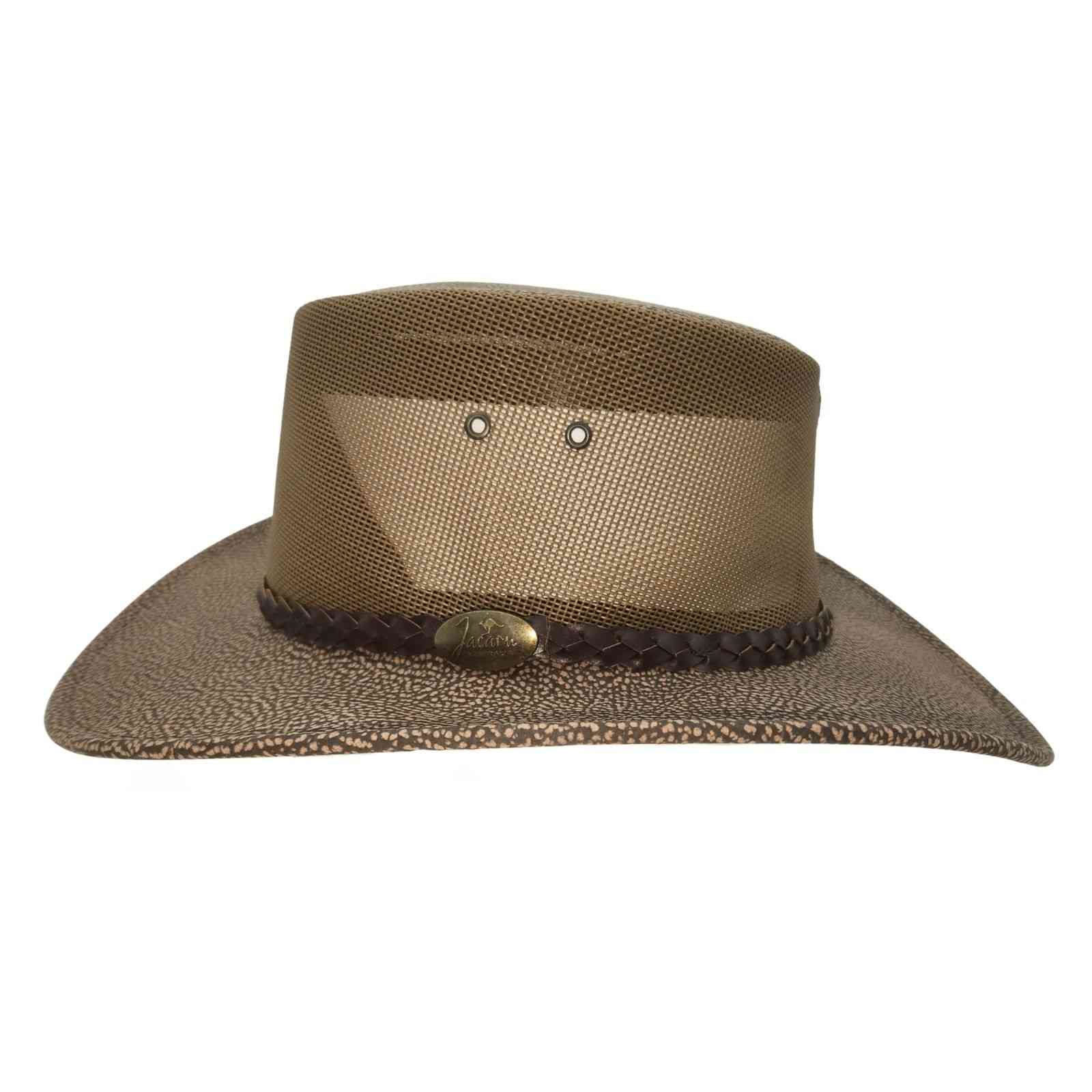
Where the 3-Piece prioritises portability, the Breeze range addresses a different problem entirely: heat management during sustained physical activity. Jacaru's Breeze sub-collection incorporates ventilation features into the crown design, making these hats the stronger choice for trail use, farm work, or extended outdoor days in warm climates. When ambient temperatures climb and exertion levels are high, a hat that traps heat quickly becomes a liability. The Breeze models acknowledge that sun protection alone is not enough; airflow matters equally for comfort and performance in genuine outdoor conditions.
Exotic Variants: Statement Pieces and Premium Gifts
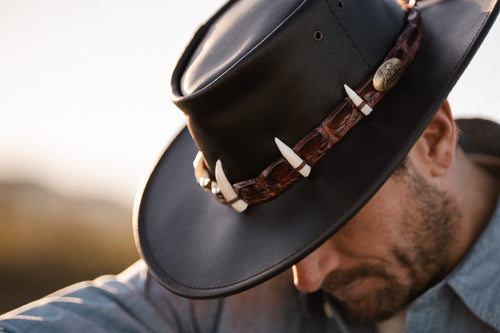
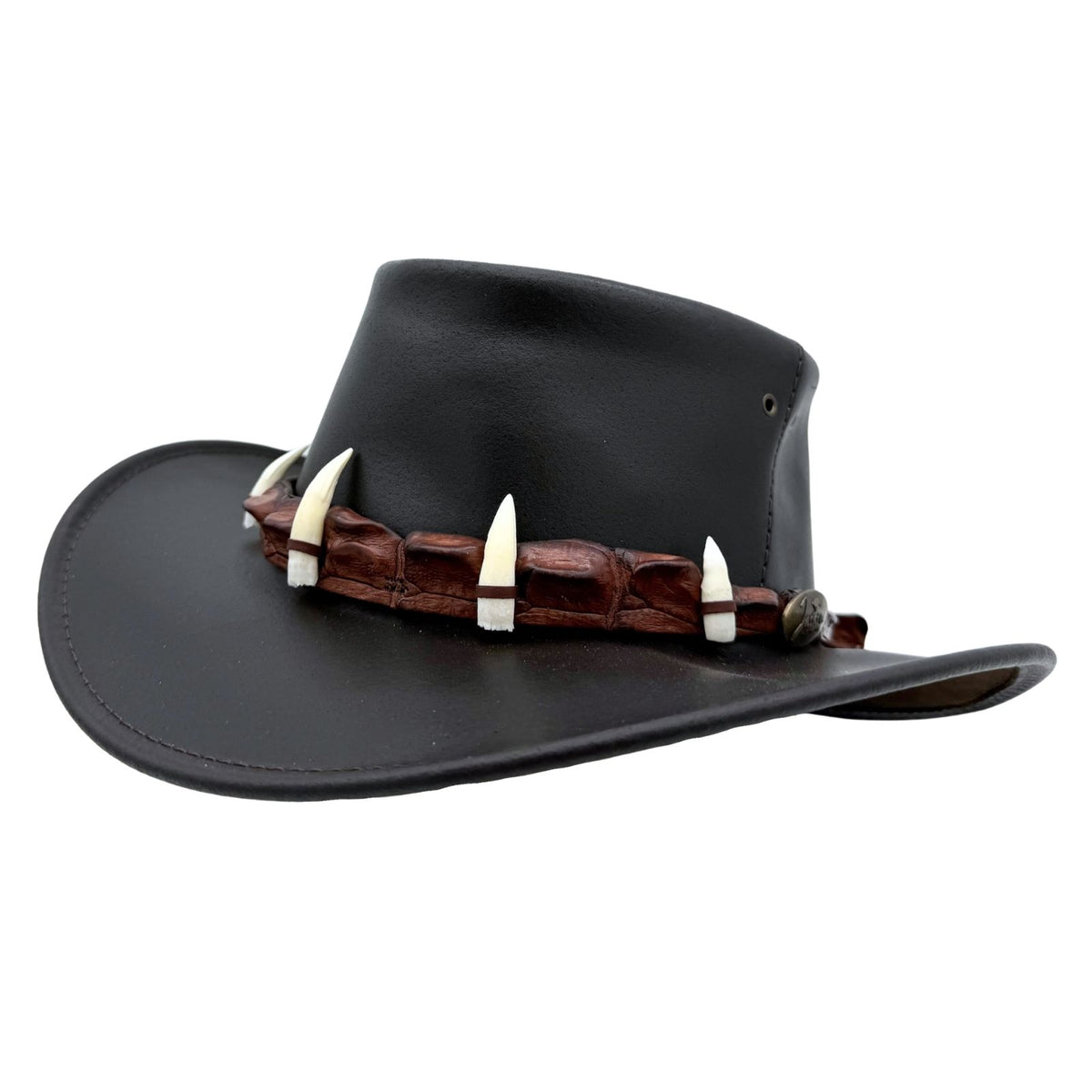
The Exotic range occupies a different register entirely. Models featuring genuine crocodile teeth and backstrap hatbands, built in the Crocodile Dundee tradition that Jacaru has maintained for decades, are as much wearable Australian cultural artefacts as they are functional outback hats. They carry strong visual impact and serve naturally as premium gifts or collector pieces for travellers who want something genuinely distinctive.
Brim Width and the Sun Protection Trade-Off
Brim width is the variable that most directly affects UV protection across the range. Wider-brimmed outback styles offer full coverage for the face, ears, and neck, making them the correct choice for high-UV Australian conditions or equatorial travel. Narrower profiles, such as the Kangaroo Trilby, trade that coverage for a more versatile silhouette that moves comfortably between outdoor and urban settings without looking out of place.
For gift buyers, the decision narrows to a clear trade-off: the 3-Piece ships and arrives without distortion, which makes it a reliable choice regardless of distance. Exotic variants deliver stronger visual impact when unwrapped, but the recipient needs to be the right fit for that kind of bold statement piece.
Jacaru vs. Barmah: An Honest Side-by-Side for Kangaroo Leather Hats
If you're researching kangaroo leather outback hats and have landed on both Jacaru and Barmah as options, you're already in a stronger position than most buyers. Both are legitimate Australian brands with genuine craft credentials, and both appear regularly in enthusiast discussions on platforms like Reddit's r/hats and The Fedora Lounge. This is not a comparison between a premium brand and a budget alternative. It is a comparison between two credible producers with different strengths, and the right choice depends on what you're actually buying the hat to do.
Brand Awareness and Market Presence
Barmah carries significant organic reach in the kangaroo leather category, particularly among international buyers encountering Australian outback hats for the first time. One YouTube review of a Barmah kangaroo leather hat has accumulated over 93,000 views, a figure that reflects genuine search-driven discovery rather than manufactured promotion. That level of video reach translates to real first-impression brand authority for buyers entering the category cold. Jacaru's own YouTube presence is smaller by comparison, though third-party retailer reviews, including coverage from Hats By The Hundred, confirm consistent independent validation of product quality and durability.
Where Jacaru's Range Architecture Pulls Ahead
The clearest differentiation is range depth. Jacaru's lineup spans functional outback styles, breeze hats built for ventilation, ladies and children's cuts, and a dedicated Exotic Hats sub-category featuring genuine crocodile teeth and custom hatbands. Add a wholesale and corporate gifting portal, and Jacaru covers contexts that a core outback hat range simply does not address. For buyers who want a statement piece or a premium gift alongside a functional trail hat, that breadth matters.
Travel Functionality and the Packable Question
For travel-focused buyers, the Jacaru Kangaroo 3-Piece has documented waterproof and packable credentials confirmed through third-party retailer reviews, placing it in direct functional competition with Barmah's equivalent packable styles. Both options hold up on the core travel criteria.
The Distribution Reality
The practical decision often comes down to how you prefer to buy. Jacaru operates directly through jacaru.com with multi-currency checkout spanning 50-plus currencies and international shipping. Barmah has a wider physical retail footprint, which is a genuine advantage for buyers who want to assess fit and feel before committing. Neither model is objectively better; they serve different purchasing preferences.
Waterproof, Packable, and Built to Last: How to Care for a Kangaroo Leather Hat
Kangaroo leather carries its water resistance as a built-in material property, not as an afterthought applied at the finishing stage. The dense, tightly interlocked fibre structure of kangaroo hide retains natural oils that create an inherent barrier against moisture, a characteristic that most cowhide hats only achieve after dedicated chemical waterproofing treatments. This means a Jacaru kangaroo leather hat arrives travel-ready in a way that goes beyond surface-level coating. That said, no leather is maintenance-free, and preserving those natural oils over years of sun, salt air, and hard use requires a straightforward conditioning routine.
Conditioning and Drying Correctly
Apply a dedicated leather conditioner or a natural beeswax-based product every six to twelve months to keep the hide supple and water-resistant. Hats used frequently in coastal or high-UV environments will benefit from the shorter end of that interval, while occasional-use hats can be maintained annually. Jacaru publishes care guidance directly at their care instructions page, which is worth consulting alongside any conditioning product's own directions. When the hat gets thoroughly wet, dry it at room temperature only. Direct heat sources such as radiators, dashboards, and hair dryers will accelerate moisture evaporation faster than the fibre structure can compensate, pulling oils out and leaving the leather brittle and prone to cracking. Prolonged submersion is similarly damaging; it over-softens the fibre matrix and can distort the hat's shape in ways that are difficult to reverse even after drying.
Packing and Shape Recovery
The Kangaroo 3-Piece hat is built specifically for travellers who cannot afford to treat their hat like fragile luggage. To pack it correctly, fold the brim gently inward without pressing a hard crease into the leather, store the hat crown-down inside a breathable bag, and allow it to re-form naturally after travel. The same material properties that make it packable also make it self-recovering; given time and room temperature, the hat returns to its original profile without intervention.
Sweatband Maintenance
The interior sweatband is the most overlooked part of any leather hat care routine. Salt deposits and skin oils accumulate in the band over time, gradually degrading both the leather and the stitching that holds the band in place. A light wipe with a barely damp cloth, followed by thorough air-drying before the hat is stored or worn again, is sufficient to prevent this build-up. In humid climates or during high-activity use, increase this cleaning frequency. Consistent sweatband care adds measurable life to the hat's interior and keeps the fit comfortable across years of regular wear.
Buying a Jacaru Kangaroo Leather Hat as a Gift: What to Know Before You Order
A Jacaru kangaroo leather hat stands apart from the broader category of Australian souvenir headwear because it is built to perform outdoors, not merely to sit on a shelf. This functional credibility is what separates it from the decorative souvenir hats that fill airport gift shops. When a recipient wears a Jacaru hat into the field, onto a trail, or through a rainstorm, it holds up. That combination of genuine Australian provenance and real-world utility makes it one of the few premium gift options that carries both cultural authenticity and practical longevity.
Ordering from Overseas
International gift buyers can transact directly through jacaru.com, which supports multi-currency checkout across AUD, USD, GBP, EUR, JPY, and dozens of additional currencies. The packable construction of the Kangaroo 3-Piece model is a specific advantage for international delivery; unlike rigid structured hats that arrive with crown distortion after passing through parcel networks, the 3-Piece can be folded flat and resume its shape on the other end. For time-sensitive orders, it is worth contacting Jacaru directly to confirm current shipping timeframes to your destination before placing the order.
Corporate and Bulk Gifting
Jacaru operates a dedicated wholesale portal for trade and corporate buyers, with the Exotic and Kangaroo leather ranges offering strong options for client gifting, conference merchandise, or recognition awards where a distinctively Australian product is the stated brief.
Sizing and the Exotic Range
Jacaru hats are measured in centimetre head circumference. If the recipient's size is unknown, selecting an adjustable-fit model or contacting Jacaru for guidance is the practical solution; the site also offers digital gift cards as a clean workaround. For buyers where narrative impact is the priority, the Exotic range, including Crocodile Dundee style hats with genuine crocodile teeth, represents the highest gift tier in the catalogue. Buyers importing exotic-component hats should verify any relevant customs or import restrictions for their destination country before ordering.
The Bottom Line on Jacaru Kangaroo Leather Hats
Kangaroo leather's tightly interlocked fibre structure delivers a weight-to-durability ratio that cowhide and buffalo hide cannot match at equivalent thickness. That material reality is not a marketing position; it is the foundational reason a kangaroo leather hat remains a logical long-term investment for anyone who intends to wear it hard across years of outdoor use, travel, and variable weather.
For buyers matching a model to a purpose: the 3-Piece construction suits travellers and active outdoor buyers best, given its confirmed packability and water resistance. The Breeze range addresses warm-climate and high-activity use cases where ventilation is the priority. The Exotic variants serve gift buyers who want visual impact and a genuinely Australian cultural story attached to the object.
Barmah is a credible alternative in this category and worth considering. Jacaru's practical edge for non-Australian buyers lies in its range depth across kangaroo, straw, wool, and accessories, combined with multi-currency international checkout that removes friction from the purchase. You can review the full kangaroo leather hat range at jacaru.com directly to compare current models and pricing.
On sustainability: kangaroo leather sourced from Australia's government-managed wild harvest sits among the more defensible ethical choices available in premium leather goods in 2026. No dedicated farming system is involved; the supply chain operates under regulated quotas, which is a meaningful distinction from conventional bovine leather.
Browse the current range at jacaru.com and use the model guidance above as your starting filter.
Conclusion
Jacaru kangaroo leather hats are not for everyone, but for the right buyer, they represent a genuinely exceptional investment. Here is what the evidence tells us. First, kangaroo leather outperforms cowhide in strength-to-weight ratio, making these hats lighter and more resilient over time. Second, the craftsmanship behind each Jacaru hat reflects decades of Australian manufacturing expertise. Third, the premium price is justified for serious outdoor use, though casual wearers may find comparable value elsewhere.
If you want a hat that rewards daily wear, ages beautifully, and holds its shape through real-world conditions, Jacaru deserves a serious look. Browse the current range, compare styles against your specific needs, and invest in headwear built to outlast the alternatives.
A great hat is not just an accessory. It is a decision you make once and never regret.


Our friends at Bocchetta Plush Toys have a great range of lifelike plush animals that make great gifts for people of all ages.