






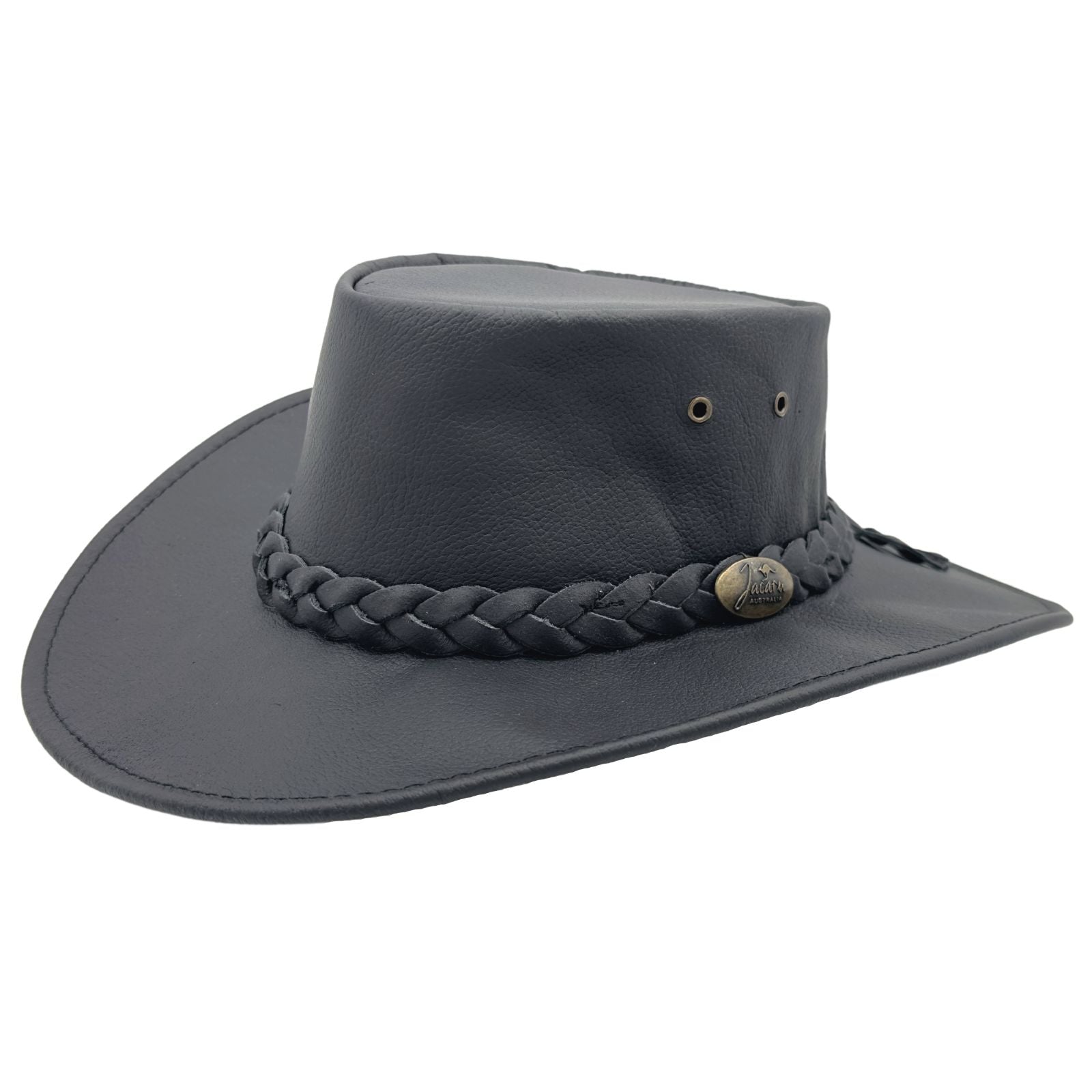


Outback Kangaroo Hat vs. Other Materials: What to Know Before You Buy

When it comes to choosing the right hat for rugged outdoor adventures, the material matters more than most people realize. Not all hats are created equal, and if you have been comparing options, you have likely come across the outback kangaroo hat as a standout choice in the premium headwear market. But how does it actually stack up against other popular materials like wool, cotton, and synthetic fabrics?
The answer involves more than just aesthetics. Durability, weather resistance, breathability, and long-term value all play a role in determining which hat deserves a spot on your head. Kangaroo leather, in particular, brings a unique set of properties to the table that sets it apart from conventional options, yet it also comes with considerations that every informed buyer should understand before committing.
In this comparison, you will get a clear breakdown of how kangaroo leather performs against competing materials across key categories. Whether you are a serious outdoor enthusiast or simply looking for a hat built to last, this guide will give you the knowledge to make a confident, well-informed purchase decision.
Why Material Matters in an Outback Hat
Not all outback hats are built equal, and the material is the single most important variable separating a hat that lasts a decade from one that fails its first wet season. The category spans a genuine spectrum: natural and synthetic straw, wool felt (including the fur-felt construction popularised by Australian heritage makers), full-grain cowhide, buffalo hide, and kangaroo leather. Each material responds differently when the conditions turn demanding, and those differences become impossible to ignore once you move beyond light recreational use into genuine outdoor environments.
Real Australian conditions are unforgiving testers. Wet scrub pushes moisture into a hat's brim and crown repeatedly throughout a single day. Prolonged UV exposure degrades untreated or low-grade hides, causing cracking and stiffening within a season. Heavy pack movement creates constant friction against the hatband and brim edge. Straw hats, particularly natural straw varieties, can lose structural integrity under sustained rain, with brim distortion occurring after even a single heavy downpour. Wool felt performs admirably in cooler and moderate conditions but can saturate and distort when rain exposure is prolonged. Leather, particularly full-grain kangaroo and cowhide, sheds surface water effectively and resists abrasion in dense scrub in ways that fashion-oriented materials simply cannot match. You can explore how different materials perform across these variables in this guide to picking the right hat material.
Buyers also need to understand the investment context clearly. Kangaroo and cattle leather hats in the Australian market typically sit in the $80 to $300 AUD range, placing them firmly in considered-purchase territory rather than impulse-buy territory. This is not a category where the cheapest option represents acceptable risk. A hat at this price point is expected to perform across multiple seasons and improve with wear rather than degrade. Getting the material decision wrong at the point of purchase means replacing an expensive item well before its design lifespan.
What makes comparison shopping difficult in this category is that marketing language across brands has become nearly uniform. Terms like "durable," "weather-resistant," and "breathable" appear on product pages from virtually every manufacturer without measurable differentiation. As Henri Henri's guide to hat materials notes, each material carries distinct performance characteristics, yet retail copy routinely flattens those differences into identical-sounding superlatives. The evaluation framework that follows cuts through that noise by assessing each material against specific, testable conditions rather than adjective-based claims.
Kangaroo Leather: What Makes It Different
The answer starts at the molecular level. Kangaroo hide contains a uniquely uniform collagen fibre structure throughout its full thickness, with no loose, spongy subcutaneous layer of the kind found in cattle hide. That lower layer in cowhide acts like a foam underlay; it compresses, stretches, and eventually sags under repeated stress and moisture exposure. Kangaroo hide lacks this layer entirely, producing a tighter, more robust fibre network from surface to base. According to the Kangaroo Leather Guide 2026, this higher collagen density combined with low fat content is the foundational reason every other performance property follows. CSIRO-funded research, detailed in Enhancing the Unique Properties of Kangaroo Leather, confirms the material warrants serious scientific attention, with species-level differences showing grey kangaroo skins achieving higher tear strength than red kangaroo equivalents.
Strength, Weight, and Abrasion Resistance
That dense fibre architecture translates directly into a strength-to-weight ratio that no cattle hide can match at equivalent thickness. Kangaroo leather can outlast cowhide up to three times its own thickness, while remaining noticeably lighter on the head. For a hat worn across a full working day or a long international journey, that weight difference compounds quickly. The tight fibre orientation also resists abrasion more effectively than looser-grained leathers; critically, when the material is punctured or torn, the fibre network resists damage propagation rather than unravelling around the site of impact. One important caveat is worth understanding: this strength advantage is thickness-dependent. Kangaroo leather must be compared at equivalent thickness to cowhide to demonstrate its superiority, and buyers should seek products where construction quality reflects the material's full potential.
Water Resistance, Patina, and Origin
Water resistance in kangaroo leather is largely a function of structure rather than surface chemistry. The tightly packed fibre network impedes moisture absorption at a material level, shedding surface water more effectively and resisting saturation better than leathers with looser grain. This matters practically in an outback hat context: a hat body that sheds a downpour without softening or losing its crown shape is a functional tool, not just a style statement.
With consistent wear, kangaroo leather develops a deepening patina that stiffens and conforms to the wearer's head shape, improving fit and character over years rather than degrading. The material rewards use. Jacaru sources its kangaroo leather through Australia's national commercial harvest programme, a regulated framework operating under strict government quotas. As noted by Maverick Leather Company, kangaroo is among the strongest leathers available for its weight. That performance story, backed by traceable, regulated Australian origin, is the standard against which every other outback hat kangaroo leather should be measured.
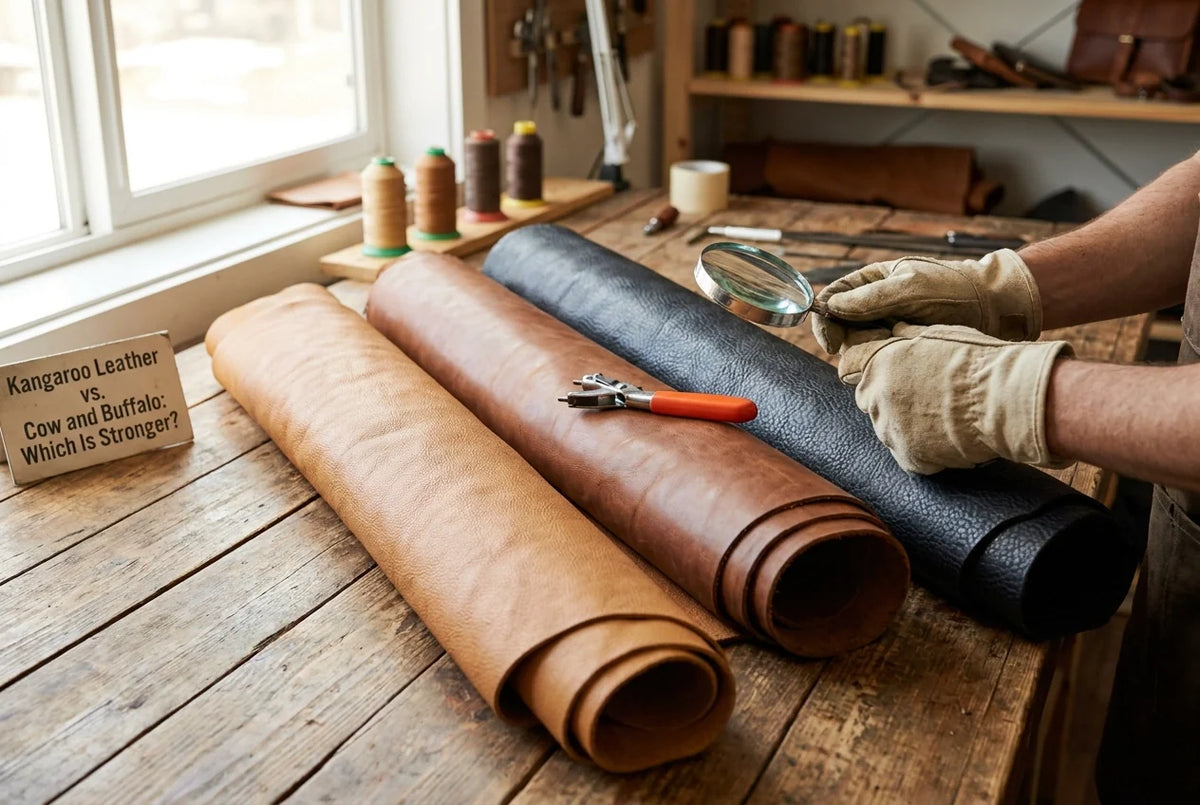
Kangaroo vs. Cowhide vs. Buffalo Leather

With that molecular foundation established, it helps to see how kangaroo hide actually compares against the two other leather options available in quality outback hats: cowhide and buffalo.
Cowhide: Reliable, But Heavy for Its Strength
Cowhide is the most widely available leather used in outback hat construction and represents the accessible entry point into the leather hat category. It is a proven, familiar material with decent durability under normal outdoor conditions. The trade-off is straightforward: cowhide carries more weight per millimetre of thickness than kangaroo, and its collagen structure is less uniform, making it more susceptible to stretch under prolonged load or sustained moisture exposure. For a hat worn on a single afternoon trail, this barely registers. For a hat worn across consecutive long days in variable conditions, the cumulative weight and gradual loss of structural tightness become noticeable. Cowhide remains a practical choice for buyers prioritising cost accessibility over peak performance, but it concedes ground on the strength-to-weight comparison.
Buffalo Leather: Maximum Toughness, Reduced Comfort
Buffalo leather steps up the durability profile considerably. It is thicker and denser than cowhide, giving it strong abrasion resistance that suits heavy scrub work and genuinely punishing environments. A buffalo leather outback hat can take substantial physical abuse without showing significant surface wear. The limitation is comfort over time. Buffalo's added bulk and coarser grain translate to a heavier hat that creates more fatigue on extended all-day wear, particularly across mixed trail and travel itineraries where the hat is rarely removed. It is purpose-built for heavy utility, which makes it an excellent choice for a narrow set of use cases, but a less versatile option for the buyer who needs a hat to function equally well on a ridge walk and in a city layover.
Kangaroo Leather: The Strength-to-Weight Benchmark
Kangaroo leather outperforms both alternatives in the metric that matters most for a hat worn in serious outdoor conditions: strength-to-weight ratio. As covered in the Kangaroo Leather Hats vs Cowhide: Aussie Showdown comparison, kangaroo hide delivers equivalent structural performance at a thinner, lighter hide weight. Community testing data puts kangaroo approximately 20% lighter than cowhide at equivalent thickness, with superior abrasion resistance that allows construction at reduced thickness without sacrificing protection. For a hat buyer, this means a kangaroo leather outback hat sits comfortably on the head without inducing the neck and shoulder fatigue that heavier hides produce over long days. The tighter grain also gives kangaroo a cleaner, more refined surface finish that ages into a well-defined patina rather than softening into a loosened texture.
Choosing Between the Three
For buyers who need a hat to perform across both trail and travel contexts, kangaroo's combination of lighter weight, tighter grain, and superior abrasion resistance gives it a clear functional and aesthetic advantage over cowhide and buffalo alternatives. Cowhide suits the buyer prioritising familiarity and entry-level pricing. Buffalo suits a specific heavy-duty scrub and utility application. Kangaroo serves the broadest range of conditions with the least compromise.
Jacaru produces outback hats across all three leather types, which is a meaningful point of difference in a category where most makers offer a single material. The ability to compare kangaroo, cowhide, and buffalo options within a single Australian brand, at consistent quality standards, means a buyer can make a genuinely informed material decision rather than defaulting to whatever a single-option retailer stocks. For a deeper overview of what that selection looks like in practice, the Kangaroo Leather Hats: The Complete Buyer's Guide outlines the full range of considerations.
Kangaroo Leather vs. Fur-Felt Outback Hats
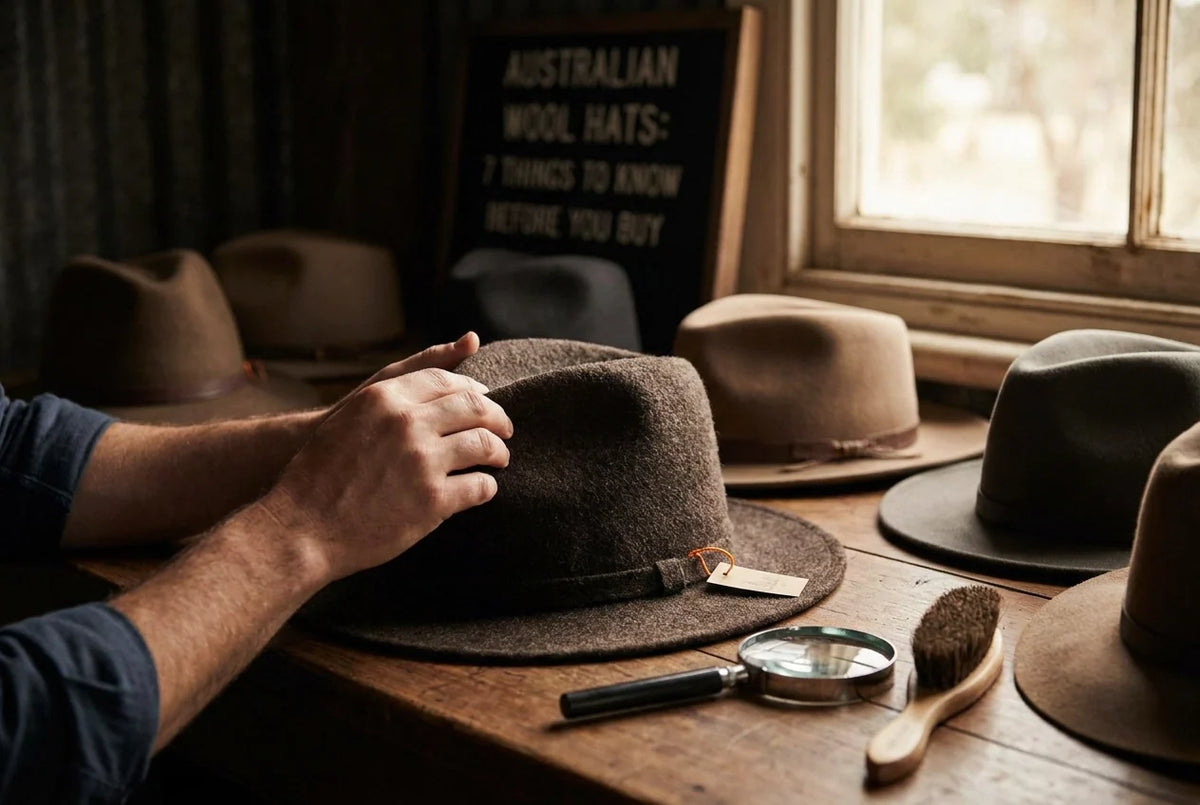
Fur-felt hats, typified by Akubra-style construction, hold a legitimate and well-earned place in the outback hat category. Built from fine wild rabbit fur, the interlocking fibre structure creates genuine breathability that leather cannot replicate at the same level. In dry or temperate conditions, this translates to real wearing comfort during extended outdoor activity. The hat body is also lighter off the shelf, which matters for buyers prioritising all-day comfort in low-humidity environments. For casual outdoor wear, station work in reliable dry climates, or everyday town and country use, a quality fur-felt hat is a proven and practical choice with over a century of Australian heritage behind it.
The critical limitation emerges the moment sustained rain arrives. The same fibre structure that gives fur-felt its breathability and flexibility is its structural vulnerability in wet conditions. Rain acts on a felt hat much like steam acts during the blocking process: it loosens the interlocking fibres, allowing the brim to droop and the crown to lose its set shape. Restoring a saturated felt hat requires careful manual repositioning and slow drying, and in severe cases, professional re-blocking. Higher quality felts recover more reliably, but the distortion risk is inherent to the material and cannot be engineered away entirely.
Kangaroo leather responds to moisture in the opposite manner. The dense, uniform collagen structure that was covered in the previous section sheds surface water rather than absorbing it, so the hat body retains its moulded shape through extended wet-weather exposure. There is no fibre loosening, no brim droop, and no re-blocking requirement after a downpour. This structural stability is a practical advantage that compounds over years of use in coastal, tropical, or consistently wet environments.
Abrasion resistance provides the second significant differentiator. In dense scrub, riders and bushwalkers push through vegetation that repeatedly contacts hat brims and crowns. Felt fibres pill, snag, and thin progressively at these contact points. Leather resists abrasion through material density, developing a surface patina rather than degrading. This guides Jacaru's approach to positioning kangaroo leather hats as purpose-built tools for serious outdoor environments rather than occasional-use items.
The practical recommendation is scenario-based. Fur-felt suits dry climates, temperate conditions, and lighter recreational use where breathability is the priority. Kangaroo leather is the better long-term investment for travel, coastal living, serious bush work, or any context where moisture and abrasion are recurring factors rather than rare exceptions.
The Sustainability Question: Is Kangaroo Leather Ethical?

For eco-conscious buyers in Europe and North America, the ethics question surrounding kangaroo leather is a genuine purchase barrier. Addressing it with facts rather than defensiveness is the most credible response available, and the evidence is substantially in kangaroo leather's favour.
Australia operates one of the most rigorously managed commercial wildlife harvest programmes on the planet. Only four species are permitted for commercial harvest, all of which are also the four most populous: the red kangaroo, eastern grey kangaroo, western grey kangaroo, and wallaroo. Annual culling quotas are typically set at 10 to 20 percent of regional populations, enforced under both state and federal legislation, and governed by a national code that explicitly prohibits targeting female kangaroos with young. None of the four harvested species appear on the CITES endangered species list, and national populations regularly exceed 30 to 40 million animals. For full context on how this framework operates, the ethics case for kangaroo leather is examined in detail by Lockhart Boot Blog.
The byproduct argument is the most important point for eco-conscious buyers to understand. Kangaroos are not farmed. The population management cull occurs regardless of whether commercial leather production exists. If the hides are not utilised, they go to landfill. Buying a kangaroo leather hat does not increase the number of kangaroos harvested; it recovers value from material that would otherwise be discarded. This contrasts sharply with cattle or buffalo hide, which requires dedicated land clearing, permanent water infrastructure, and feed production to generate. Kangaroo leather carries none of that agricultural footprint.
The counterargument from activist organisations, including Collective Fashion Justice and Animal Wellness Action, centres on animal welfare concerns and has been influential enough to prompt major sportswear brands including Nike, Adidas, Puma, and ASICS to publicly exit the kangaroo leather category. These are real positions held by credible campaigners, and buyers will encounter them. However, the withdrawals were driven primarily by campaign pressure rather than ecological evidence; academic analysis published by The Conversation argues a US ban on kangaroo leather would itself constitute an animal welfare disaster, not a solution to one.
The final sustainability consideration is longevity. A well-maintained kangaroo leather hat from a verified Australian maker will realistically last two to three decades. Any credible lifecycle analysis places that durability well ahead of synthetic alternatives, most of which are plastic-based, test at less than 30 percent bio-based content in independent assessments, and take more than 500 years to decompose in landfill.
Provenance matters here too. Jacaru sources within Australia's regulated harvest framework, giving buyers an auditable, traceable supply chain. Products distributed through generic online marketplaces without verifiable Australian origin carry unknowable sourcing risk, and no amount of "kangaroo leather" labelling substitutes for that traceability. As Jacaru's own buyer guide explains, verified Australian manufacture is the practical assurance that regulation, welfare standards, and material authenticity have all been observed from hide to finished hat.
Australian Heritage and the Crocodile Dundee Connection
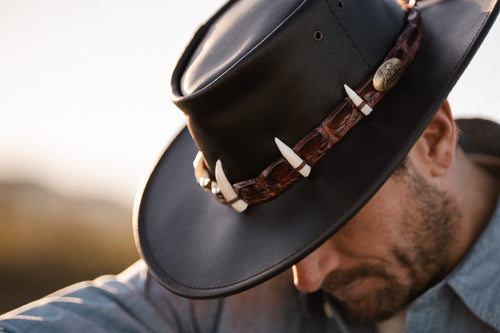
Few pieces of popular culture have shaped global perceptions of an entire nation the way the Crocodile Dundee films did. When Paul Hogan's Mick Dundee stepped onto cinema screens in 1986, wearing a wide-brimmed leather hat adorned with crocodile tooth detailing, that silhouette became an immediate international shorthand for Australian adventure. The film's director, Peter Faiman, later acknowledged that Paul Hogan's work served as a "cultural bridge from Australia to the world," fundamentally repositioning Australia as a destination defined by rugged authenticity. That iconic Crocodile Dundee hat did not just dress a fictional character; it created a lasting visual identity that international audiences still actively associate with genuine Australian outback culture.
For international buyers, this cultural reference point functions as a real purchasing motivation. The demand remains commercially demonstrable: social media posts featuring Crocodile Dundee-style hats continue to attract significant engagement, with buyers actively enquiring about sizing and availability. A 2025 TikTok video by custom hat-maker WILD HATS featuring a Crocodile Dundee-inspired hat accumulated over 24,000 views, with the maker noting that authentic crocodile-detailed hatbands are simply not widely available at the mass-market level. That gap is precisely where authentic Australian production matters.
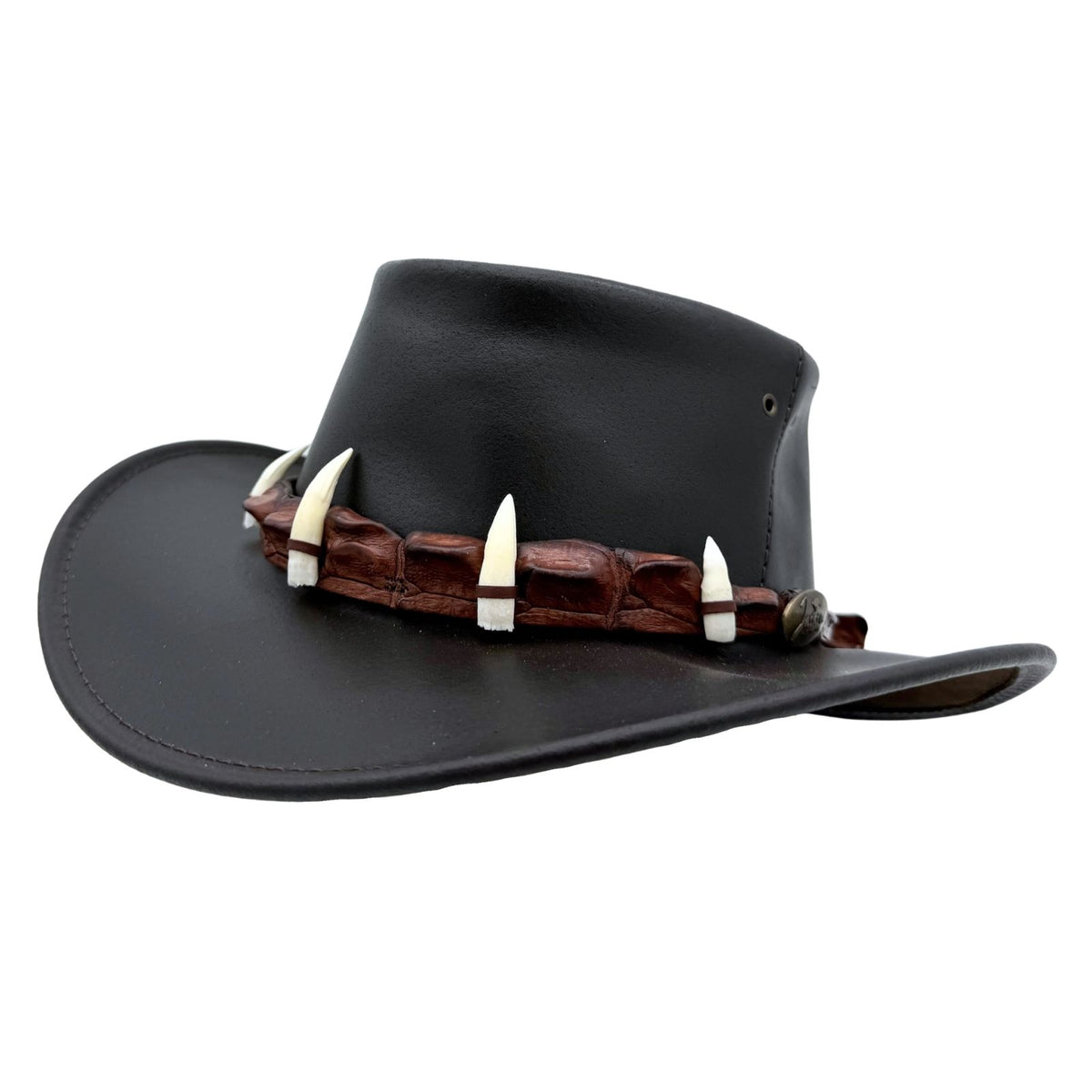
Jacaru occupies this niche with genuine materials rather than costume approximations. Their Crocodile Dundee-style hats feature real crocodile teeth and backstrap hatbands, produced in Australia using premium leathers. For gift buyers and souvenir shoppers, this combination of recognisable cultural heritage and verified Australian craftsmanship creates a value proposition that imported generic alternatives fundamentally cannot match. Buyers are not purchasing a prop; they are acquiring a piece of authenticated Australian identity, and that distinction carries meaningful weight across international markets including the United States, United Kingdom, Europe, and Japan.
How to Care for a Kangaroo Leather Outback Hat
Of all the maintenance steps available to a kangaroo leather hat owner, conditioning is the one that genuinely cannot be skipped. Kangaroo hide is thinner than bovine leather and its tightly aligned collagen fibres, while exceptionally strong, have less internal fat content to sustain suppleness over time. A quality conditioner, ideally one formulated for fine or exotic leathers such as a lanolin-based or beeswax-based product, should be applied every two to three months under regular use, and more frequently in dry or arid climates where the hide is exposed to prolonged heat. Applying a small amount with a soft cloth in circular motions, then allowing it to absorb fully before wearing, takes less than ten minutes and directly prevents the cracking and brittleness that ends the life of neglected leather hats prematurely.
Wet-weather handling is the second area where most owners make costly mistakes. When a kangaroo leather outback hat gets thoroughly soaked in rain, the instinct to speed up drying with a hair dryer or by placing the hat near a heater is understandable but genuinely damaging. Uneven heat causes the leather fibres to contract at different rates, producing permanent stiffness across the crown and accelerated surface cracking along the brim edges. The correct approach is simple: shake off excess water, place the hat on a hat stand to maintain its crown shape, and allow it to dry completely at room temperature. For guidance on preserving shape through the drying process, this detailed leather hat care guide from Kakadu Traders Australia is a practical reference.
For everyday cleaning, a soft cloth dampened with clean water handles light trail dust and surface grime effectively. The critical rule is to avoid submerging or soaking the hat. Even kangaroo leather treated with water-resistant finishes can lose structural integrity in the hat body if saturated for extended periods. Wipe, do not soak.
Storage deserves more attention than most owners give it. During off-season periods, a kangaroo leather hat stored crown-down, or with items stacked on top of the brim, will develop set-in distortions that are difficult to reverse. Storing the hat upright on a hat stand, or inside a hat box with the brim free from compression, preserves the brim geometry and crown profile through months of disuse. In humid climates, ensuring the storage space has adequate ventilation also prevents the mould growth that can develop beneath a sweatband in sealed containers.
Finally, the patina that builds across the surface of a well-maintained kangaroo leather hat over months and years is the material's most distinctive quality signal. The surface deepens in tone, develops subtle variations in colour around high-wear points, and acquires a richness that no new hat can replicate. This is not wear damage; it is the leather recording genuine use while remaining structurally sound, which is precisely what specialist leather hat care instructions consistently affirm about quality kangaroo leather products built to last.
Who Should Buy a Kangaroo Leather Outback Hat?
Outdoor Adventurers and Active Users
Outdoor enthusiasts who regularly work or play in conditions that punish ordinary headwear will extract the greatest functional value from a kangaroo leather outback hat. The material's abrasion resistance holds up against dense scrub, fence lines, and rough pack storage in a way that fur-felt simply cannot match. Its moisture-shedding surface handles light to moderate rain without the distortion risk that affects felt brims under prolonged saturation. For fishing, trail work, camping, or any high-UV environment where a reliable brim is non-negotiable, kangaroo leather earns its place on pure performance grounds.
Global Travellers and Souvenir Buyers
For international visitors to Australia, or anyone seeking a genuinely Australian souvenir, kangaroo leather is the most defensible material choice available. It is sourced exclusively from Australia under the National Kangaroo Management Program, giving it a traceable, regulated supply chain that no imported or synthetic alternative can replicate. A kangaroo leather outback hat is not a generic souvenir; it is a material artefact of the country itself. Jacaru's Complete Buyer's Guide to Kangaroo Leather Hats outlines why this provenance matters to buyers who want their purchase to carry a genuine story rather than a sticker.
Gift Buyers and Corporate Purchasers
A kangaroo leather outback hat occupies a compelling niche for gift buyers: it sits above generic tourist merchandise in quality and narrative weight, without crossing into luxury fashion pricing. For corporate buyers, Jacaru's range across kangaroo, cowhide, and buffalo leather provides meaningful options at different price and impact points. The Crocodile Dundee style, complete with genuine crocodile teeth detailing, is particularly well suited to high-impact corporate gifting where memorability matters. The Ultimate Guide to Jacaru Hats confirms Jacaru's positioning alongside other credible premium Australian brands, which is useful context when evaluating corporate gifting credentials.
Women Seeking Outback Leather Hats
Women looking for a kangaroo leather outback hat face a genuinely underserved market. Most brands in this category default to unisex or male-fit styles with no dedicated women's range. Jacaru's Ladies' Hat collection addresses that gap directly, offering styles designed for women within the same premium Australian-made standard as the broader range. If you are shopping for a women's kangaroo leather hat, this is a segment worth exploring with care, because dedicated options are rare and the quality differential between purpose-built and adapted styles is noticeable in fit and finish.
Jacaru's Kangaroo Leather Hats: Authentically Australian
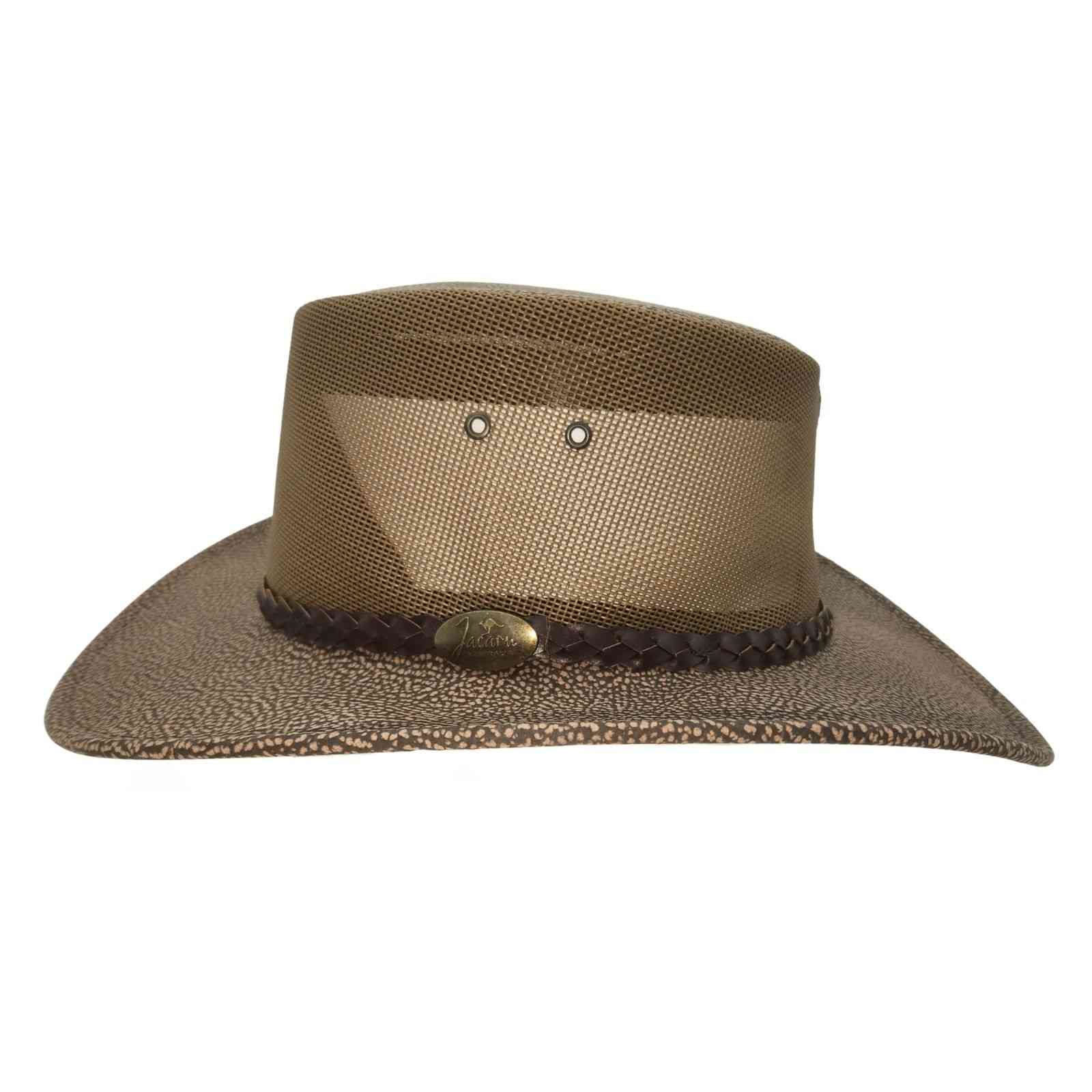
For buyers who have completed the material comparison and are ready to commit to kangaroo leather, Jacaru offers the most direct and verifiable path to an authentically Australian-made outback hat. Founded in Australia and manufacturing from Australian-sourced materials, Jacaru produces a full range of kangaroo leather hats spanning classic outback crowns, breeze-vented styles, ladies' cuts, and the iconic Crocodile Dundee-style hat with genuine crocodile teeth and backstrap hatbands. That last detail matters: it is not a cosmetic nod to Australian heritage but a specific construction choice that places Jacaru in a category of its own among outback hat makers.
The provenance question is where Jacaru's Australian manufacturing heritage becomes a genuine functional differentiator, not just a marketing position. Mass-distributed alternatives routed through third-party marketplaces carry inherent uncertainty about sourcing, tanning methods, and actual country of manufacture. Jacaru's complete leather hat collection is made in Australia from Australian-sourced hides, giving buyers the material traceability and manufacturing story that no marketplace-distributed product can replicate with the same specificity.
International buyers are well served by Jacaru's direct-to-consumer store, which supports purchasing across a wide range of currencies including USD, GBP, EUR, and CAD. This removes the need to route through third-party platforms and delivers a hat with a verified Australian origin directly to the buyer's door.
Beyond hats, Jacaru operates as a complete destination for Australian-made goods. The range extends to kangaroo leather keyrings, fur accessories, oilskin products, and corporate gift options, including gift cards and wholesale purchasing pathways for trade buyers. For anyone who has worked through the material comparisons covered in this guide, Jacaru represents the most straightforward, credentials-backed choice available in the kangaroo leather outback hat category.
Making the Right Choice for Your Outback Hat
The evidence across this comparison points consistently in one direction. Kangaroo leather outperforms fur-felt in wet and scrub conditions, outperforms cowhide and buffalo in strength-to-weight terms, and carries a sustainability credential backed by Australia's transparent national harvest programme. Care is straightforward: condition regularly, dry naturally after wet exposure, and store away from direct heat. Follow those three steps and a quality kangaroo leather hat will outlast cheaper alternatives by years, not months.
Provenance matters in this category. Buying direct from an established Australian maker like Jacaru gives you verified material sourcing, genuine manufacturing heritage, and access to styles, including the iconic Crocodile Dundee silhouette, that generic alternatives simply cannot replicate. For buyers ready to explore the full range, Jacaru's complete kangaroo leather hat buyer's guide is a practical next step.
Use this comparison as a decision framework: shortlist by material first, then by style. Identify the conditions where you will actually wear the hat, match those conditions to the right material, and then choose the silhouette that suits you. That sequence protects your investment and ensures the hat you buy performs exactly where you need it to.
Conclusion
Choosing the right hat comes down to understanding what each material truly offers. Kangaroo leather stands out for its exceptional durability, natural weather resistance, and lightweight strength that most competing materials simply cannot match. While wool and cotton serve casual or budget-conscious buyers well, they fall short in demanding outdoor conditions. Synthetic options offer affordability but sacrifice the long-term value and authenticity that serious adventurers expect.
If you are ready to invest in headwear that performs as hard as you do, the outback kangaroo hat deserves serious consideration. Browse reputable retailers, handle the material in person when possible, and ask about craftsmanship details before buying.
The right hat is not just an accessory; it is a long-term companion for every adventure ahead. Choose wisely, and your hat will reward you for years to come.


Our friends at Bocchetta Plush Toys have a great range of lifelike plush animals that make great gifts for people of all ages.