








The Best Leather Cowboy Hats: Materials, Style and Durability

There is something timeless about a well-crafted leather cowboy hat. Whether you are riding through open terrain, attending a country music festival, or simply want to elevate your everyday style, the right hat makes all the difference. But not all cowboy hats are created equal, and choosing the best one requires a solid understanding of materials, construction, and long-term durability.
A quality leather cowboy hat is more than just an accessory. It is an investment in craftsmanship that, with proper care, can last decades. From full-grain leather to suede finishes, the options available today span a wide range of styles, price points, and performance levels. Knowing what separates a great hat from a mediocre one will save you both money and frustration.
In this guide, we break down the top leather cowboy hats on the market, examining what makes each one stand out in terms of material quality, aesthetic appeal, and everyday wearability. By the end, you will have everything you need to make a confident, informed purchase that suits your lifestyle and personal taste.
What to Look for in a Leather Cowboy Hat
Not all leather cowboy hats are built equal, and understanding what separates a genuinely superior hat from a disappointing impulse purchase can save you both money and frustration. Here are the five variables that matter most.
1. Leather Type
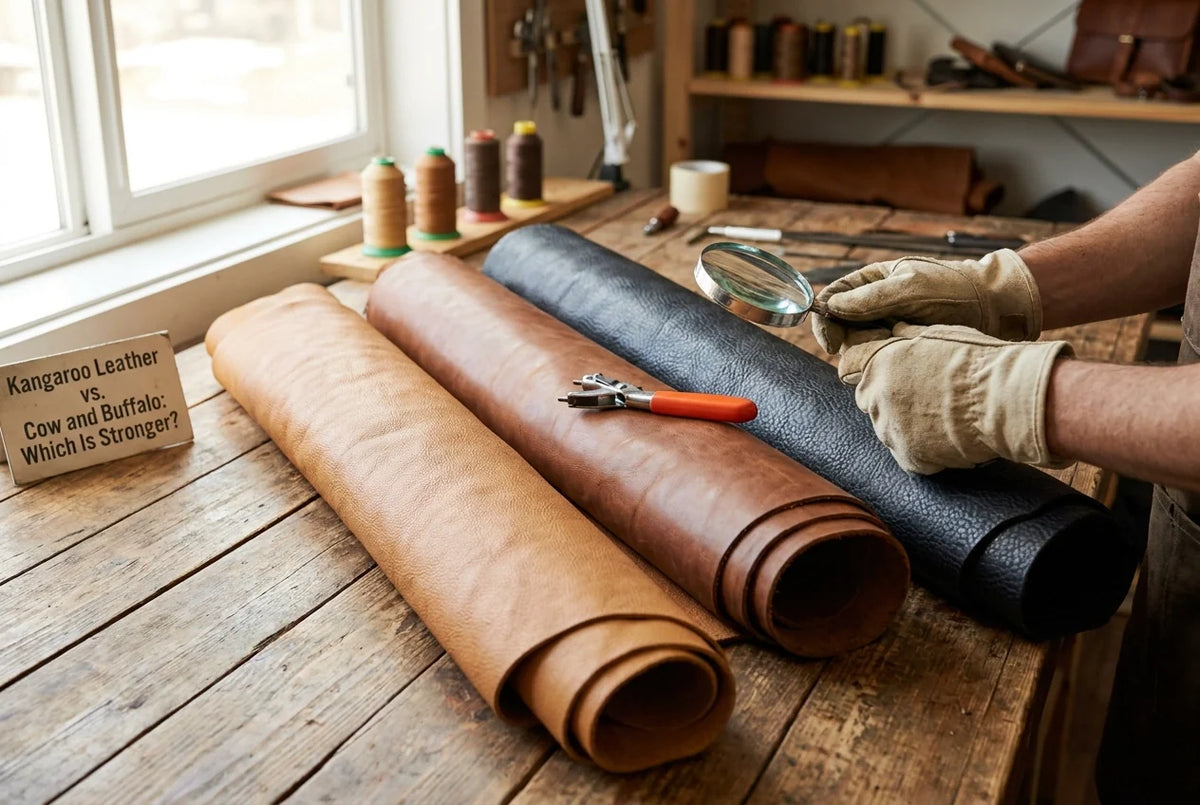
Leather type is the single most consequential decision you will make. Kangaroo leather delivers a strength-to-weight ratio up to 10 times greater than cowhide per unit of weight, thanks to its uniquely dense, parallel collagen fiber structure. At just 1 to 1.2mm thick, it is simultaneously lightweight, tear-resistant, breathable, and naturally water-repellent, making it the top-tier choice for outdoor adventurers and frequent travellers. Buffalo leather sits at the opposite end of the spectrum, offering maximum rugged bulk and impressive tensile strength for extreme conditions, though its heavier weight and stiffer hand reduce breathability and packability considerably. Cowhide occupies the accessible mid-range: durable, widely available, and reasonably supple, but heavier than kangaroo and more prone to cracking without regular conditioning. Your intended use case should drive this choice decisively.
2. Brim Width
Brim width governs both sun protection and style identity simultaneously. A brim of 3 inches or more delivers meaningful shade and supports UPF 50+ ratings, blocking approximately 98% of UVA and UVB radiation. This makes wide-brimmed designs essential for outdoor work, travel in high-UV environments, or extended time in the Australian outback and similar climates. Narrower brims trade functional coverage for a cleaner, fashion-forward silhouette better suited to urban or festival settings.
3. Crown Shape
Crown shape defines the hat's overall character and versatility. The classic Cattleman crease, with its deep centre crease and side dents, delivers a balanced, immediately recognisable Western silhouette. A Gus or open crown offers a sloping profile with distinctive side pinches, adapting naturally to outback and adventure aesthetics while allowing personal reshaping over time.
4. Packability
Full-grain kangaroo leather at 1 to 1.2mm thickness can be rolled or compressed and will spring back without permanent creasing, a critical advantage for travellers packing into backpacks or overhead luggage. Stiffer cowhide and felt alternatives lose their shape far more readily under compression, making them poor companions on the road.
5. Warranty and Construction
Construction details and warranty terms are the clearest indicators of genuine quality. A 10-year warranty, handmade construction, and reinforced chinstraps signal a hat built to last decades rather than seasons. Mass-market imports typically priced between $35 and $59 on platforms like Amazon frequently use lower-grade materials, thinner hides, and offer little to no warranty coverage. The price difference reflects a fundamentally different product philosophy, not just a brand premium.
The Best Leather Cowboy Hats for Every Style and Purpose
Now that you know what to look for, here are the top picks across every major buyer category, each evaluated on material quality, construction, intended use, and value.
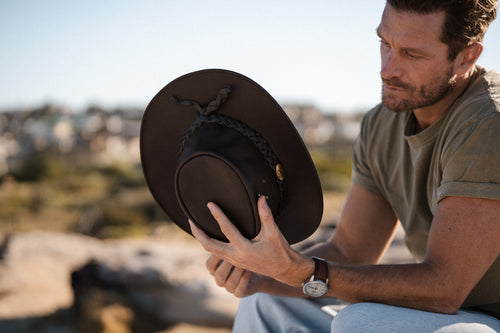
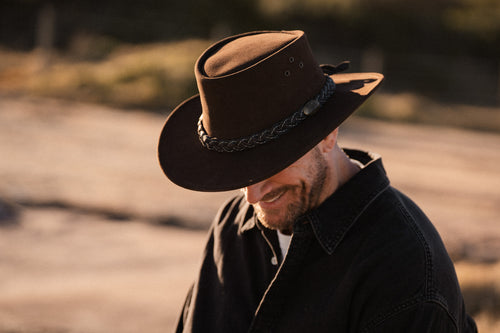
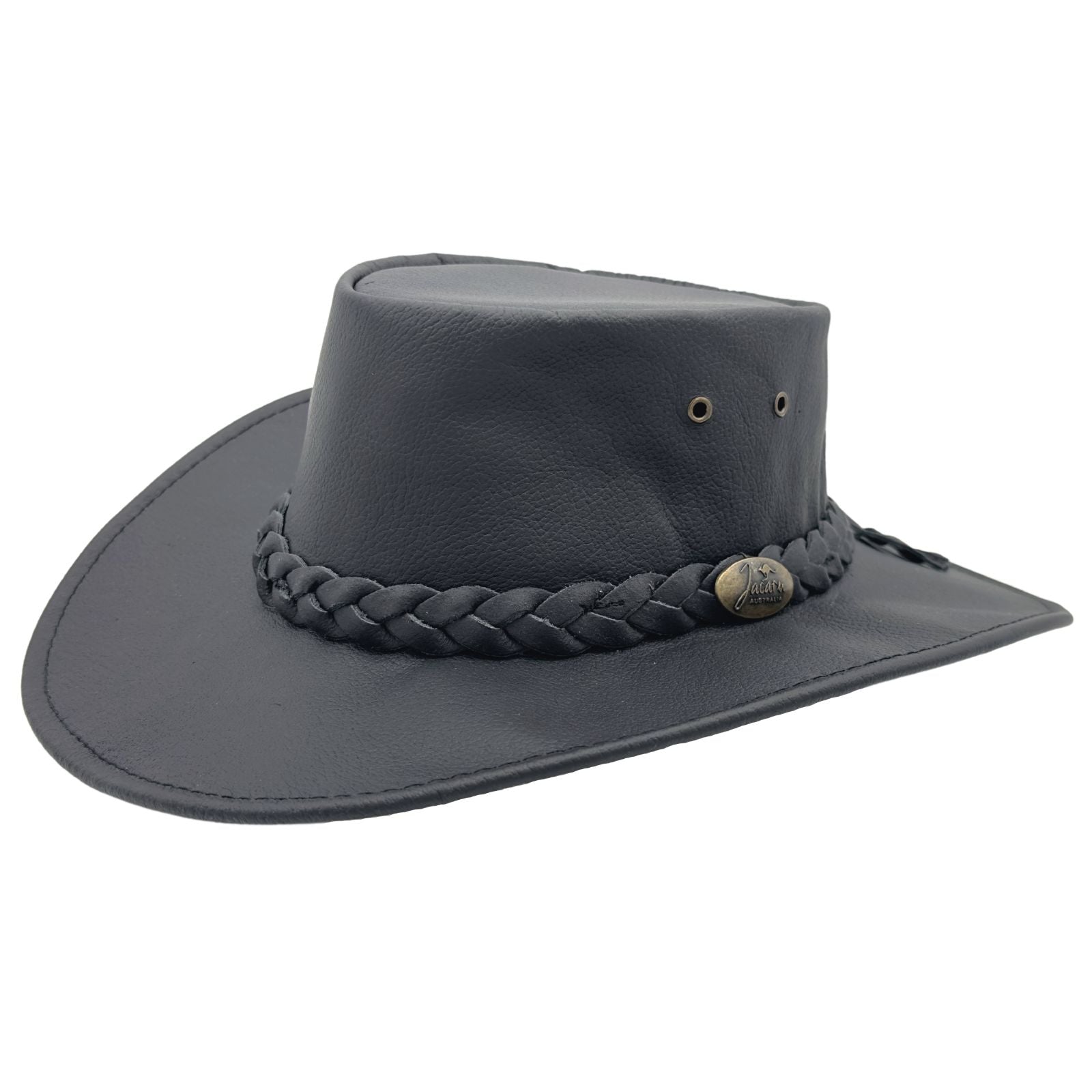
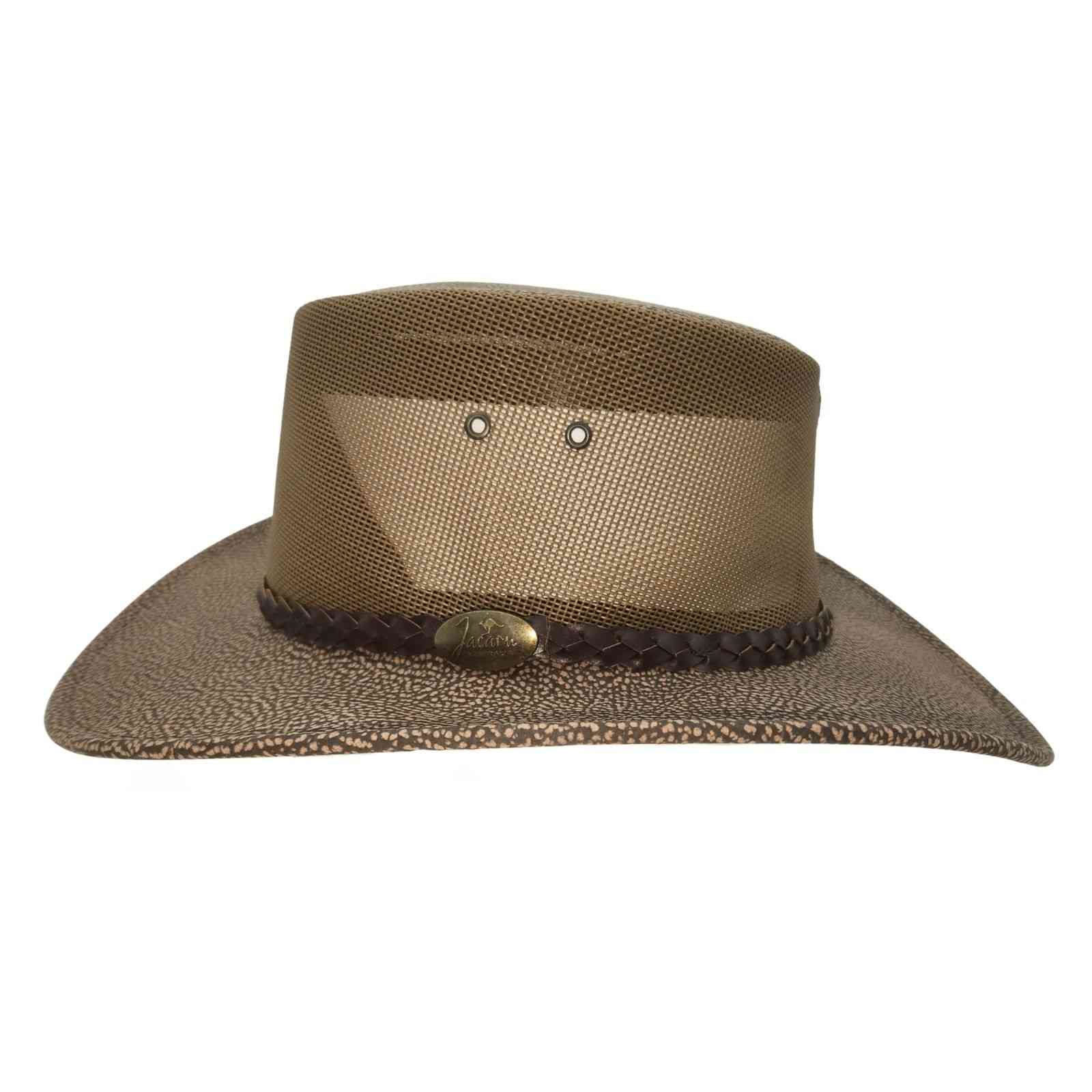
1. Best Overall: Jacaru Kangaroo Leather Hat (1001) The Jacaru kangaroo leather hat collection sets the premium Australian-made benchmark. Handcrafted from genuine kangaroo hide that is up to 10x stronger than cowhide per unit of weight, the 1001 features a classic outback profile with a 3.25-inch brim, ventilated crown, water-repellent finish, and UPF 50+ sun protection. Priced around $87 USD, it delivers exceptional value for intermediate buyers seeking a versatile, lightweight kangaroo leather cowboy hat built to last.
2. Best for Adventure: Jacaru Packable Kangaroo Leather Hat Purpose-built for travelers, Jacaru's crushable kangaroo leather models compress into a cloth bag and rebound without losing shape, making this the definitive packable leather hat for travel. An adjustable chinstrap, breathable eyelets, and featherlight 1 to 1.2 mm leather construction keep it functional across climates and terrain.
3. Best for Durability: Jacaru Buffalo Leather Hat (1069) For buyers demanding maximum toughness, the buffalo leather cowboy hat option delivers a thicker, heavily textured hide with serious all-weather resilience, backed by Jacaru's 10-year warranty.
4. Best Sustainable Option: Jacaru Kangaroo Leather Kangaroo leather is wild-harvested from Australia's population of approximately 50 million kangaroos under regulated quotas, making it a genuinely low-impact material choice compared to farmed cowhide. According to market research, sustainability is an accelerating purchase driver in the global cowboy hats market, projected to reach USD 1.43 billion by 2035.
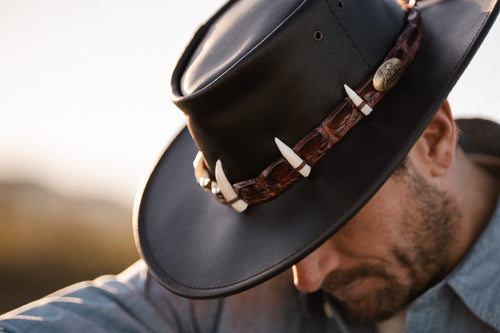
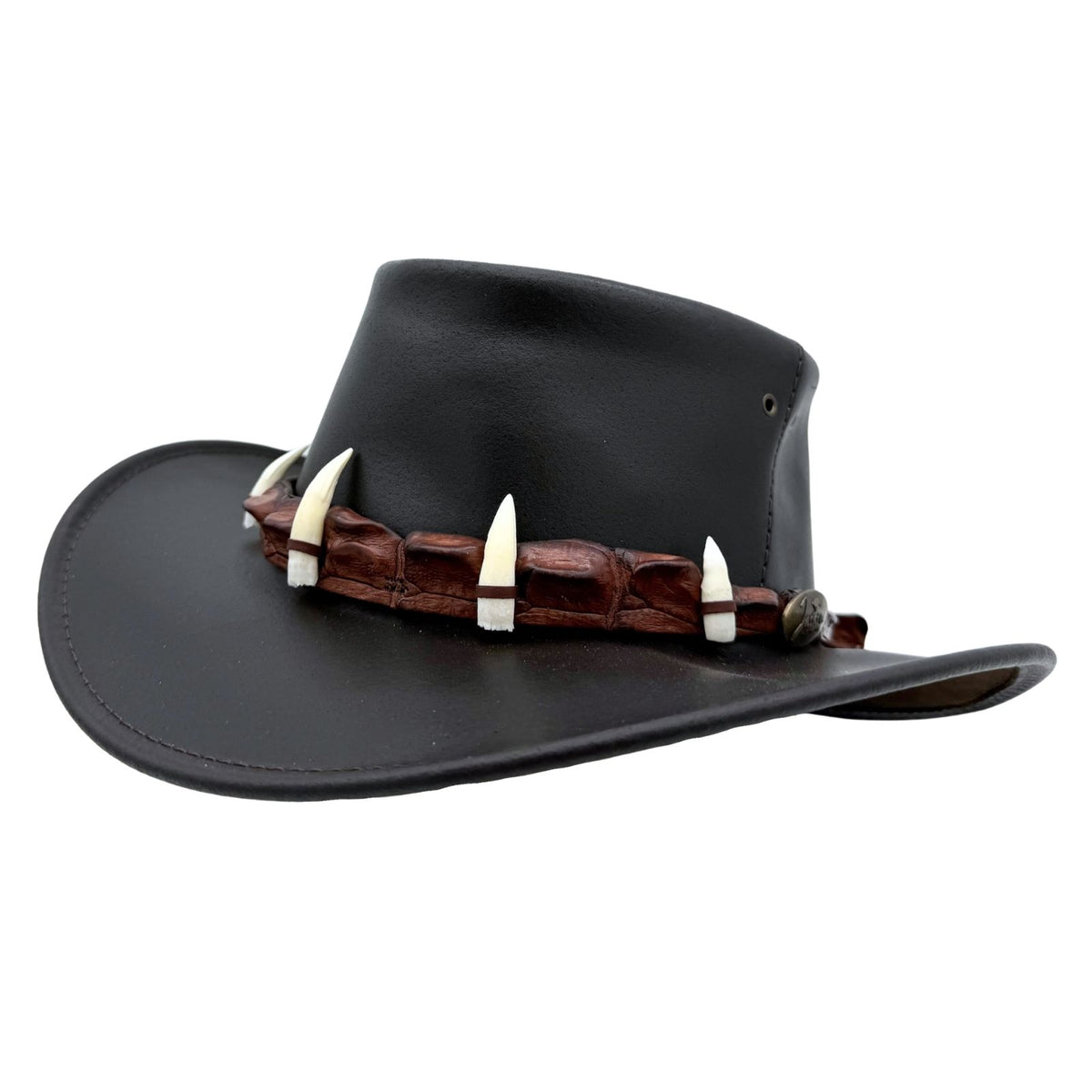
5. Best for Gift Buyers: Jacaru Crocodile Dundee Style Leather Hat Featuring genuine crocodile teeth and a backstrap hatband, Jacaru's Crocodile Dundee style leather hat arrives gift-ready with distinctive Australian heritage craftsmanship that no mass-market alternative can replicate, making it the most memorable option for gift buyers seeking something truly unique.
Best Overall: Jacaru 1001 Kangaroo Leather Hat
The Jacaru 1001 Kangaroo Leather Hat earns the top spot by delivering a combination of material science, functional design, and long-term value that mass-market alternatives simply cannot replicate. Handmade in Australia from full-grain kangaroo leather at just 1 to 1.2mm thickness, the 1001 achieves something genuinely rare in the leather hat category: it is simultaneously lightweight, crushable for travel, and rated UPF 50+ for serious sun protection. That UPF 50+ rating matters in practice. Whether you are hiking through high-UV Australian terrain or spending a full day at an outdoor festival, this hat is blocking over 98% of harmful UV radiation while remaining comfortable on your head for hours at a stretch.
What justifies the premium material choice is kangaroo leather's extraordinary strength-to-weight ratio. Independent testing and Jacaru's own materials consistently cite kangaroo hide as up to 10x stronger than cowhide per unit of weight, a result of its uniquely dense, parallel collagen fiber structure. For a daily-wear leather cowboy hat, this translates directly into long-term resilience. A standard cowhide hat subjected to repeated folding, rain exposure, and rough handling will show accelerated surface cracking and brim distortion within a few seasons. The 1001, by contrast, develops a natural character patina without compromising structural integrity, making it a genuinely better choice for outdoor punishment.
At approximately $87 USD, the 1001 sits well above the $35 to $59 price range typical of mass-market leather hats, but the value proposition holds up under scrutiny. The 10-year warranty is not a marketing footnote; it reflects the manufacturer's confidence in the material and construction. When you amortize that cost across a decade of reliable use, the per-year cost of ownership is lower than most budget alternatives that need replacing every two to three seasons.
The design versatility rounds out the case. A 7.8cm wide brim delivers meaningful shade, an optional chinstrap secures the hat in wind or active use, and the stonewash finish provides a broken-in aesthetic straight out of the box. It packs flat into a carry-on without losing its shape, making it as practical through an airport terminal as it is on an outback trail or at a summer music event. For anyone investing seriously in a leather cowboy hat built to last, the 1001 is the benchmark to measure everything else against.
Best for Adventure and Outdoor Use: The Bushranger and Croc Hunter Style
Where the 1001 establishes the foundation, the Bushranger and Croc Hunter styles push that foundation into unmistakably adventurous territory. These hats carry the same premium leather construction that makes Jacaru's core range exceptional, but layer on genuine crocodile teeth and decorative backstrap hatbands that transform a functional outback hat into a piece of wearable Australian heritage. The Croc Hunter (model 110) features authentic crocodile leather binding and a signature arrangement of crocodile teeth on the hatband, delivering the instantly recognisable silhouette made globally famous by the 1986 film. This is not cosmetic gimmickry; the crocodile elements are sourced and finished with the same attention to material quality that defines every Jacaru product.
The cultural weight behind this design is a genuine differentiator. The Crocodile Dundee aesthetic is one of Australia's most recognised exports, and international travellers actively seek it out as a souvenir with substance rather than a shelf ornament. Buyers searching for an authentic Australian outback hat or a Crocodile Dundee style leather hat will find that US-centric Western hat brands simply cannot replicate this with credibility. The story embedded in these hats, tied to Australian wilderness, genuine materials, and decades of outback iconography, is something only an Australian maker can authentically deliver.
On performance, the wide brim construction provides UPF 50+, blocking approximately 98% of UV rays. In high-sun environments, whether the Australian outback, a coastal trek, or an open-air safari vehicle, that level of protection addresses a real health consideration that purely fashion-oriented leather cowboy hats typically ignore.
The integrated chinstrap further separates these styles from decorative alternatives. Wind, trail movement, and open-vehicle travel all create conditions where an unsecured hat becomes a liability. The chinstrap solves that problem directly, keeping the hat stable during active use without sacrificing the rugged aesthetic that makes this style so compelling for genuine adventurers.
Best for Durability: Jacaru 1069 Buffalo Leather Hat
For buyers who want a leather cowboy hat built to withstand decades of serious outdoor use, the Jacaru 1069 Buffalo Leather Hat occupies a distinct and deliberate position in the lineup. Buffalo leather is thicker and denser than kangaroo leather by design, and that material difference translates directly into a hat that prioritises sheer rugged durability over lightweight packability. Where the 1001 kangaroo model rewards travellers who value a crushable, featherlight profile, the 1069 rewards buyers who want a hat that can take sustained punishment across ranch work, wet-weather hikes, and long country seasons without losing structural integrity.
The natural grain of buffalo hide is one of its most compelling long-term advantages. Unlike hats that simply weather and fade, the 1069 develops a rich, distinctive patina as it accumulates use, conditioning treatments, and exposure to the elements. Each season adds visible character to the leather's surface, making the hat look increasingly distinguished rather than worn out. Customer reviews on the official 1069 product page include buyers returning after more than ten years of heavy use, specifically noting how the leather's appearance has improved with age. That kind of ownership trajectory is rare in headwear, and it speaks to the material quality Jacaru builds into every hide selection.
Buffalo leather also carries a naturally high oil content, which contributes to inherent water resistance and makes it more forgiving in wet conditions than many cowhide alternatives. The 1069 responds well to standard leather conditioning, extending its lifespan further without demanding a complex maintenance routine. This combination of toughness, moisture resistance, and low-maintenance performance makes it a genuinely practical choice for outdoor settings where the weather cannot be predicted.
In terms of physical presence, the 1069 is a hat that commands attention. The weight and density of buffalo leather gives it a substantial, authoritative feel that suits ranch environments, country festivals, and heritage-styled occasions equally well. For gift buyers, that material presence does significant communicative work: before the recipient reads a label or checks a warranty, the hat's finish and heft signal craftsmanship and lasting quality. Backed by Jacaru's 10-year warranty and handmade Australian construction, the 1069 is one of the stronger premium gifting options in the entire outback hat category.
Best Sustainable Option: Why Kangaroo Leather Is the Ethical Choice
For buyers who factor sustainability into their purchasing decisions, the sourcing story behind a Jacaru kangaroo leather hat is one of the most transparent and verifiable in the premium leather market. Kangaroo leather is derived from wild animals harvested as a byproduct of government-regulated population management programs across Australia. With the national kangaroo population estimated at approximately 50 million, annual commercial harvest quotas are set and monitored by state wildlife authorities using aerial surveys and population modeling. Hides that would otherwise go to waste are instead processed into high-quality leather goods, making the supply chain directly traceable to a regulated, documented wildlife management system.
The environmental case is equally compelling when compared to conventional cowhide. Farmed cattle require dedicated land clearing, significant water consumption, and supplemental feed inputs. Kangaroos, by contrast, are wild and native to Australia's arid and semi-arid ecosystems, requiring no pasture conversion or irrigation. They also produce substantially less methane per animal than cattle, contributing a meaningfully lower greenhouse gas footprint per hide. For the environmentally conscious buyer, this distinction is not just marketing language; it reflects measurable differences in how the raw material reaches production.
The processing stage reinforces this position. The full-grain kangaroo leather used in Jacaru hats is finished without heavy synthetic coatings, keeping the material closer to its natural state. This approach sidesteps some of the chemical-intensive finishing processes common in mass-market leather manufacturing, as detailed in Jacaru's own material explainer.
Jacaru also recognizes that not every buyer will choose animal-derived leather, regardless of its provenance. The brand offers vegan faux leather alternatives for buyers who prefer animal-free options, reflecting a product philosophy built around serving a genuine range of values rather than assuming every customer shares identical priorities. That breadth of choice, backed by clear material sourcing and independent perspectives on kangaroo leather's pros and cons, gives sustainability-focused shoppers the information they need to make a confident, values-aligned purchase.
Best for Gift Buyers: Jacaru Leather Hats as Premium Gifts
Few gifts communicate thoughtfulness quite as effectively as something built to last a lifetime. A leather cowboy hat backed by a 10-year warranty does exactly that. Jacaru's warranty is not marketing language; it reflects genuine confidence in Australian craftsmanship, full-grain leather sourcing, and construction that holds up under real conditions. For a gift buyer, that warranty transforms the purchase from a fashion accessory into a statement: this is something worth keeping, worth wearing, and worth passing down.
The origin story behind every Jacaru hat adds a second layer of meaning that most gifts simply cannot offer. Handcrafted in Australia from materials including kangaroo, buffalo, and cow leather, each hat carries the provenance of a continent known for rugged self-reliance and distinctive cultural identity. For international travellers, Australiana enthusiasts, or recipients who genuinely care about where and how their possessions are made, that context is part of the gift itself. It is not just a hat; it is a piece of Australian heritage that arrived at their door.
Style variety matters enormously in gift buying, and Jacaru's range is broad enough to match almost any recipient. The kangaroo leather options suit adventure-focused recipients who value lightweight performance. Buffalo leather is the choice for someone who wants uncompromising toughness. The Croc Hunter styles, featuring genuine crocodile accents, make a bold, conversation-starting gift for festival-goers or those who appreciate distinctly Australian character. Faux leather alternatives round out the range for recipients with different preferences.
Jacaru also serves corporate gift buyers directly, offering wholesale options from $400 AUD minimum, making branded or curated leather hats a high-perceived-value alternative to standard corporate merchandise. For businesses in tourism, resources, or export sectors where Australian identity carries real weight, a premium leather outback hat leaves a lasting impression on clients and team members alike.
On price, the approximately $87 USD entry point sits in a practical gifting sweet spot. It is premium enough to feel considered and special, without requiring the deliberation that accompanies a major purchase. That positions Jacaru hats perfectly for Christmas, Father's Day, Mother's Day, milestone birthdays, and pre-travel send-offs, covering virtually every seasonal gifting window on the calendar.
Kangaroo vs. Cowhide vs. Buffalo Leather: Which Is Right for You?
Choosing the right leather for a leather cowboy hat is not merely an aesthetic decision. The material you select directly determines how the hat performs across weight, strength, water resistance, packability, sustainability, and price. Understanding these six dimensions gives you a clear, evidence-based framework for making the right call.
Weight and Wearability
Kangaroo leather sits at the lightest end of the spectrum, thanks to its unusually dense yet thin fiber structure. At just 1 to 1.2mm thickness, it delivers structural integrity without the bulk that makes extended wear uncomfortable. Cowhide is noticeably heavier, adding fatigue during long days outdoors or while travelling. Buffalo leather is the densest of the three, offering a substantial, grounded feel that some buyers actively prefer but which becomes a liability when comfort over extended hours matters.
Strength and Structural Performance
This is where kangaroo leather makes its most compelling case. Its interlocking collagen fiber arrangement produces a strength-to-weight ratio up to 10 times greater than cowhide per unit of weight. In practical terms, that means a thinner kangaroo leather hat can absorb more stress, resist tearing, and hold its shape far longer than a heavier cowhide equivalent. Cowhide remains reliably durable for everyday use and handles most conditions well. Buffalo leather compensates with raw material density and stiffness, excelling in long-term abrasion resistance, but its advantage is bulk-driven rather than structural efficiency.
Water Resistance and Packability
All three leathers benefit from proper conditioning and treatment, but their baseline behaviors differ. Buffalo hide offers the most inherent resistance to moisture thanks to its dense grain, handling rain, sweat, and extended outdoor exposure with minimal fuss. Kangaroo and cowhide both perform adequately when treated, with kangaroo's breathability actually making it more comfortable in warm, humid conditions despite slightly lower raw water resistance than buffalo. On packability, kangaroo leads without contest. It crushes and flexes without creasing or taking a permanent set, making it the obvious choice for travel bags, carry-on luggage, and adventure use. Cowhide is less forgiving when compressed. Buffalo is the least packable of the three, owing to its stiffness and density.
Sustainability Credentials
Kangaroo leather holds a measurable environmental advantage. Sourced as a by-product of Australia's regulated population management program across a wild population of approximately 50 million animals, it requires no dedicated farming, no land clearing, and produces a significantly lower methane footprint than farmed cattle hides. Cowhide carries the highest environmental cost of the three, tied directly to the resource intensity of livestock agriculture. Buffalo leather falls between the two, sourced from farmed or managed animals in most commercial contexts, though traditional and ethical tanning operations can improve its credentials.
Typical Price Point
Cowhide is the most accessible entry point in the leather cowboy hat market, with solid options available at lower price points and wide availability. Kangaroo leather commands a justified premium reflecting its specialized sourcing and superior material properties. Buffalo leather sits at a comparable or slightly elevated price relative to cowhide for premium rugged models, reflecting both its density and sourcing requirements.
Which Should You Choose?
The decision comes down to your primary use case. Choose kangaroo leather if you travel frequently, spend extended time outdoors, or want the best strength-to-weight performance with genuine sustainability credentials. Choose buffalo leather if you work in demanding ranch or outdoor conditions where maximum material density, rugged texture, and long-term durability outweigh the need for packability. Choose cowhide if budget is your primary driver and you do not require a crushable, travel-ready design. Each material has a legitimate place in a buyer's decision, but for most active, travel-oriented buyers, the performance data behind kangaroo leather makes it the most versatile and defensible choice across the widest range of conditions.
How to Style a Leather Cowboy Hat in 2026
The Cowboy Core movement shows no signs of retreating in 2026. From the dusty festival grounds of Coachella to the runways of London and Paris, the 2026 headwear report from DC Fashion Week confirms that Neo-Western styling has evolved well beyond novelty status into a legitimate wardrobe pillar. The key shift is intentionality: the most compelling leather cowboy hat looks in 2026 blur the boundary between ranch utility and urban polish rather than leaning entirely into either direction. Stylists working Coachella 2026 describe the dominant aesthetic as "desert Western," grounded in functional materials, relaxed silhouettes, and a deliberate avoidance of anything that reads as costume. That distinction matters enormously when building outfits around a premium leather hat.
1. Work Within the 2026 Color Palette
Earth tones are the non-negotiable foundation of leather cowboy hat styling this year. Tan, saddle brown, camel, black, and ivory dominate both retail shelves and street-style photography, with stonewash and pre-weathered finishes carrying particular weight because they signal authenticity rather than novelty. A hat that looks like it has a story is more compelling than one that looks freshly unboxed. Jacaru's stonewash kangaroo leather hats arrive with exactly that quality built in, offering a rugged, lived-in surface that pairs naturally with the neutral wardrobe staples most wearers already own. When your hat and your outfit share the same earthy register, the whole look coheres without effort.
2. Apply Ranch-to-Runway Pairing Principles
The most versatile formula for styling a leather cowboy hat in 2026 is straightforward: wide-leg trousers or tailored denim, a simple linen shirt or heavyweight cotton tee, and clean leather boots or Chelsea boots. This combination works equally well on a Sydney rooftop bar, a Queensland outback station, or a boutique hotel terrace in Marrakech. The logic is contrast: structured tailoring or quality denim provides the urban anchor, while the leather hat introduces the rugged, outdoor dimension. What the formula explicitly avoids is full-Western saturation; no spurs, no fringe overload, no head-to-toe Western branding. One strong piece carries the aesthetic; everything else plays a supporting role.
3. Solve the Travel Problem With a Packable Kangaroo Leather Hat
Festival and travel styling introduces a practical constraint that most hats fail to meet. Shaped felt hats require a hatbox; structured brims cannot be folded into a carry-on without permanent damage. Kangaroo leather resolves this entirely. At just 1 to 1.2 mm thickness and with a natural resilience that allows folding and rolling without creasing, a Jacaru kangaroo leather hat fits into a carry-on bag, springs back to full shape on arrival, and requires no restyling between day and evening wear. For a traveller moving from a morning hike to a rooftop dinner, that versatility is not a minor convenience; it is the difference between bringing the hat and leaving it at home. UPF 50+ sun protection adds functional value that completes the travel case.
4. Choose the Outback Aesthetic for a Distinctive Point of Difference
For global travellers who want a leather cowboy hat with genuine cultural provenance, the Australian outback aesthetic offers something no generic Western look can replicate. Jacaru's Crocodile Dundee heritage designs, featuring genuine crocodile teeth and backstrap hatbands, carry a specific story that invites conversation rather than blending into a crowd. These hats reference a real tradition, made from real materials, produced in Australia by craftspeople who have been building outback hats for decades. That provenance reads clearly to other well-travelled people, and it positions the wearer as someone who sought out the real thing rather than a broadly available approximation. In 2026, when authenticity is the most valued quality in premium accessories, that distinction is exactly what separates a memorable hat from a forgettable one.

How to Care for Your Leather Cowboy Hat
A leather cowboy hat built from premium full-grain material is an investment that rewards attentive care with decades of performance. The following five practices form a complete maintenance routine suited to kangaroo, buffalo, and cowhide leather hats alike.
1. Condition Regularly to Prevent Cracking and Drying
Leather is a natural material that continuously loses moisture through sun exposure, wind, sweat, and dry climates. Without replenishment, the hide stiffens, becomes brittle, and eventually cracks in ways that cannot be reversed. Apply a leather-appropriate conditioner, such as a dedicated leather balm or cream, every three to six months under normal use. Increase that frequency if you wear your hat daily, live in an arid climate, or spend significant time outdoors in high heat. Apply a thin, even layer with a soft cloth, work it gently into the leather including the underside of the brim where sweat accumulates, and allow full absorption before wearing. Avoid over-application, as excess product can leave residue and attract dust rather than nourish the hide.
2. Apply Waterproofing Before First Wear and After Heavy Rain
Kangaroo and buffalo leather carry natural water resistance due to the dense, tightly packed fibre structure that makes these materials so durable. That inherent resistance, however, has limits under sustained wet-weather exposure. A waterproofing treatment applied before first wear creates a protective barrier that reduces water ingress and prevents rain from saturating the leather and distorting the crown or brim. Reapply after any heavy downpour or deep cleaning session, as both events diminish the protective layer. Use a product specifically formulated for leather hats, such as a wax-based balm or spray, and allow adequate drying time before wearing. These treatments preserve breathability while adding meaningful protection for trail use, travel, and unpredictable weather.
3. Embrace Patina as Part of the Hat's Character
Full-grain kangaroo and buffalo leather darken, deepen in tone, and develop distinctive markings over time through contact with sun, sweat, natural skin oils, and regular handling. This process, known as patina, is not a sign of wear or neglect; it is evidence of a living material responding to use in the way only genuine leather can. Each hat develops its own unique appearance over years of wear, becoming distinctly personal to its owner. Regular conditioning helps guide that development evenly, preventing blotchiness while allowing the natural aging process to unfold. Patina is one of the clearest markers that separates authentic full-grain leather from lower-grade or synthetic alternatives.
4. Store Correctly to Maintain Crown Shape
Heat and direct sunlight are among the most damaging forces a leather hat can face outside of actual wear. Prolonged exposure causes the leather to dry prematurely, fade unevenly, and lose structural integrity faster than normal use would produce. Store your hat in a cool, dry, shaded location away from car dashboards, windowsills, or heating vents. Use a hat block, a rounded form, or a dedicated hat stand to maintain the crown shape during storage; this is especially important for hats shaped with a defined Cattleman crease or Gus crown, where the structured form is central to the hat's character. Avoid storing hats inside sealed plastic bags, which trap condensation and promote mildew growth in the leather.
5. Clean Gently and Use the Right Products
Most surface dust and light marks respond well to a slightly damp, soft cloth applied with minimal pressure; this handles the majority of routine maintenance without introducing unnecessary moisture to the leather. For deeper soiling, use a specialist leather cleaner rather than household detergents or soap-based products. As noted in guidance from leather hat care specialists, common household cleaners strip the natural oils from the hide, accelerating the very drying and cracking that conditioning is designed to prevent. Blot rather than rub when addressing stains, allow the hat to dry naturally in a well-ventilated area away from direct heat, and follow any cleaning with a light conditioning treatment to restore moisture balance. For stubborn staining or significant damage, a professional leather restoration service will always produce better results than aggressive home remedies.

Why an Australian-Made Leather Hat Is Worth the Investment
Every detail examined so far in this guide points toward the same conclusion: not all leather cowboy hats are created equal, and the gap between mass-market imports and a handmade Australian product is measurable, not just marketing language. Here are five reasons why a Jacaru kangaroo leather hat represents a genuine long-term investment rather than simply a higher upfront cost.
1. A 10-Year Warranty That Mass-Market Imports Cannot Match
Jacaru backs its Australian-made leather hats with a 10-year warranty covering product faults with free repairs. This is not a policy that manufacturers selling at the $35 to $59 price point can structurally afford to offer. At those margins, replacement is the business model, not repair. A 10-year warranty requires confidence in materials, construction, and craftsmanship. It also fundamentally changes the cost-per-wear calculation: a hat that lasts a decade with covered repairs outperforms three or four cheaper replacements in both value and environmental terms.
2. Handmade Construction Produces Quality That Automated Assembly Cannot Replicate
Each Jacaru hat passes through the hands of skilled Australian craftspeople rather than a factory line calibrated for throughput. The difference shows in fit, finish, and the integrity of material selection at every stage of construction. Quality control applied by an experienced maker catches inconsistencies that automated processes routinely miss. For a product worn in demanding outdoor conditions, that attention to construction detail is the difference between a hat that holds its shape through years of use and one that loses structure after a single wet season.
3. Kangaroo Leather Carries a Provenance No Other Country Can Claim
Australia is the only country that produces kangaroo leather at commercial scale. That singular origin gives Jacaru a material story that no non-Australian manufacturer can authentically replicate. Beyond provenance, the material science is equally compelling: kangaroo leather is up to 10 times stronger than cowhide per unit of weight, breathable, water-repellent, and packable at just 1 to 1.2 mm thickness. It is a leather category defined entirely by its geography.
4. You Are Buying Into a Growing Premium Market, Not a Fading Niche
The global cowboy hat market was valued at $2.1 billion in 2024 and is forecast to reach $3.7 billion by 2033, a CAGR of 6.2%. That growth is concentrated in premium, story-driven products as consumers move away from disposable fashion toward pieces with verified quality and authentic origin. Choosing a handmade Australian leather hat places you on the right side of that market shift, with a product whose cultural and material credibility only increases over time.
5. The Total Value Equation Extends Well Beyond Price Per Wear
When comparing a mass-market import against a handmade Australian leather cowboy hat, the honest comparison includes the warranty coverage, kangaroo leather's documented durability advantages, the sustainability credentials of wild-harvested sourcing, and the irreplaceable origin story. None of those factors appear on a budget product's hang tag. Together, they represent a value equation built for buyers who measure quality in years rather than seasons.
Frequently Asked Questions About Leather Cowboy Hats
What is the best leather for a cowboy hat?
The answer depends on your priorities. Kangaroo leather leads on strength-to-weight ratio and packability, measuring just 1 to 1.2 mm thick while offering up to 10 times the tear resistance of cowhide per unit of weight. It folds and packs without creasing permanently, making it the clear choice for travellers. Buffalo leather takes the lead on raw ruggedness, with a thicker, more textured grain that shrugs off heavy outdoor abuse. Cowhide sits in the middle as the most widely available mid-range material, offering reliable performance at a lower price point.
Are kangaroo leather hats ethical?
Yes, provided the leather comes from regulated wild-harvest programs in Australia. Kangaroos are not farmed; hides are sourced as a byproduct of government-managed population culls conducted under strict licensing, humane standards, and annual quotas. With approximately 50 million kangaroos across Australia, this system carries a significantly smaller environmental footprint than cattle farming, which demands land clearing, water, and feed at industrial scale. Jacaru sources its kangaroo leather through these regulated channels, making the sustainability claim traceable and verifiable rather than marketing language.
How long does a leather cowboy hat last?
A premium full-grain leather hat, conditioned regularly and stored correctly, will last decades rather than seasons. Leather develops resilience and character over time, growing more personal with each year of wear. Jacaru formally backs many of its handmade hats with a 10-year warranty, a standard that reflects genuine confidence in materials and construction rather than a promotional gesture.
Can you wear a leather cowboy hat in the rain?
Full-grain kangaroo and buffalo leather are naturally water-resistant due to their dense fibre structure. Applying a dedicated leather waterproofing treatment before first wear, and again after heavy rain exposure, extends that protection substantially and prevents the stiffening that can occur when untreated leather dries too quickly. Allow the hat to dry at room temperature away from direct heat.
What size leather cowboy hat do I need?
Measure around the widest part of your head, just above the ears and eyebrows, using a flexible tape measure. Record that circumference in centimetres, then match it against the sizing chart provided by your chosen maker. Jacaru and other premium producers offer detailed guides for this purpose. Leather stretches slightly with wear, so a snug initial fit is normal and will ease into a comfortable, personalised shape over time.
Choosing the Right Leather Cowboy Hat: Final Takeaways
The decision comes down to how and where you plan to wear your hat. Kangaroo leather is the clear standout for travellers and outdoor adventurers: at just 1 to 1.2 mm thick and up to 10x stronger than cowhide per unit of weight, it packs into a bag without losing its shape and performs across climates without demanding constant maintenance. Buffalo leather, by contrast, suits buyers who prioritise raw material density and a deep, evolving patina over packability, making it the better call for ranch work and prolonged heavy outdoor use.
Regardless of which leather you choose, the construction markers matter as much as the material. Handmade craftsmanship, wide brim UPF 50+ sun protection, and a 10-year warranty are the clearest signals separating a genuine investment piece from a hat that will fade and fail within a season or two.
Jacaru's leather cowboy hat collection stands apart because no mass-market import can replicate its combination of Australian origin, verified material science, and craftsperson-backed warranty. The provenance story is real, traceable, and built on decades of production expertise.
Whether you are buying for yourself or searching for a gift that communicates lasting thoughtfulness, a hat from a maker with this level of accountability is measured in decades, not seasons.


Our friends at Bocchetta Plush Toys have a great range of lifelike plush animals that make great gifts for people of all ages.